A lot of restaurant owners think the secret to making money is marketing, but so often it ends up costing way more money than it ever generates because there is a right way and many wrong ways to do it. Since I focus on teaching restaurant owners how to make money through operational systems, I like to bring in outside experts to talk about restaurant marketing.
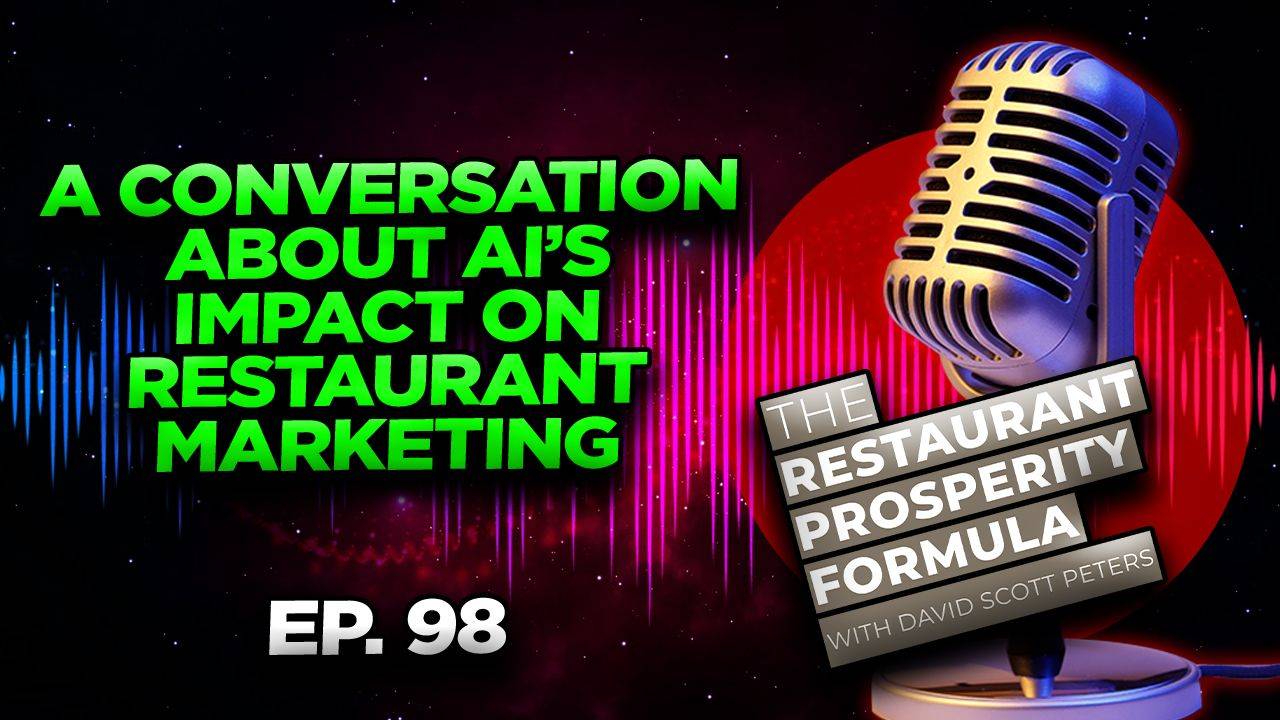
This episode of The Restaurant Prosperity Formula podcast is a discussion with Erik Shellenberger. He is an author and owner of Bar Marketing Basics, a marketing firm that focuses on bringing in new customers into your restaurant or bar. Shellenberger is a repeat guest here. He has been on a quest to help restaurant and bar owners stop buying into the myth that other restaurant marketing companies are selling and start bringing in real traffic through your doors. I’ve brought him back not be just because his first episode was so popular but because he released a new book, “If I Could Give It Zero Stars, I Would.” During our discussion he shares with you the importance of understanding how AI has changed what a restaurant needs to do to stay ahead of their competition and increase your sales.
In the ever-evolving landscape of restaurant marketing, the emergence of AI has become a game-changer. Here are the key takeaways for restaurant owners looking to leverage AI effectively:
-
AI-driven customer experience: Picture a future where AI assists customers in finding the perfect dining spot tailored to their preferences, from cuisine and menu options to pet-friendly policies and parking availability. Embracing AI means anticipating this shift and ensuring your online presence is optimized to meet these evolving customer demands.
-
Optimized online presence: Your Google Business Profile is your digital storefront, and its optimization is paramount. From descriptive language to keyword-rich photo tags, every detail matters. Utilize tools like ChatGPT to craft SEO-friendly descriptions that appeal to both customers and search engines.
-
Consistent data across platforms: Inconsistencies in business information across online directories can harm your visibility and credibility. Use services like online presence scans to ensure your data is accurate and uniform across all platforms, boosting trust with both customers and search algorithms.
-
Reputation management: Responding promptly and professionally to customer reviews, both positive and negative, is crucial. AI can assist in crafting responses that maintain professionalism and address concerns effectively, contributing to a positive online reputation.
-
Measurable results: The impact of AI-driven marketing strategies is measurable, with metrics like impressions and “get directions” clicks providing valuable insights into customer engagement and conversion rates. Embrace AI not just as a tool for efficiency but as a means to drive tangible business results.
The rise of AI presents both challenges and opportunities for restaurant owners. By embracing AI-driven marketing tactics, optimizing online presence and prioritizing reputation management, restaurants can stay ahead in a rapidly evolving digital landscape.
Click the podcast player above to listen in, or you can watch the video on YouTube, click here to download the latest episode.
Read the full transcript.
Hey there restaurant pro, it’s Dave Scott Peters and welcome to episode 98 of the Restaurant Prosperity Formula. I’ve been coaching restaurant owners since 2003 and the Restaurant Prosperity Formula is based on what the most successful restaurant owners I’ve worked with do on a daily basis to achieve their success. The basic premise of the formula centers around achieving prosperity, freedom of your restaurant and the financial freedom you deserve. To achieve prosperity, you have to follow a very specific formula made-up of leadership, systems, training, accountability, and taking action. Now I want to reintroduce you to our guest today, Eric Shellenberger, author and owner of Bar Marketing Basics, a marketing firm that focuses on bringing in new customers into your restaurant or bar. Eric is a repeat guest here on the Restaurant Prosperity Formula. Eric has been on a quest to help restaurant and bar owners stop buying into the myths that other restaurant marketing companies are selling and start bringing in real traffic through your doors. I’ve brought him back, not just because his episode was so popular, but because he released a new book entitled, If I Could Give It Zero Stars, I Would. You can easily find his new book on Amazon. Listen in on our conversation as Eric shares with you the importance of understanding how AI has changed what a restaurant needs to do to stay ahead of their competition, be seen, and increase your sales. I want to welcome Eric Shellenberger to our show today. But first, a word from our sponsor. We all know managing costs is one of the most important parts of running a profitable restaurant, especially now. But between fluctuating vendor prices, waste, labor, and the never-ending list of tasks that demand your attention on a daily basis, it can be challenging for even the most experienced of us to manage costs well. That’s where Margin Edge comes in. Margin Edge is a complete restaurant management software that automatically uses data from your POS and invoices to show you food and labor costs in real time. Don’t wait until it’s too late. MarginEdge gives you tools to make decisions in the moment, like a daily P&L, price alerts on key ingredients, and real-time plate costs, all without ever having to touch a spreadsheet. Take control of your costs, work more efficiently, and be more profitable. Go to www..marginedge.com/dsp to learn more and schedule your demo today. Eric, I want to thank you so much for taking the time to talk with me yet again here on my podcast. I appreciate you, my friend.
Thank you very much for having me.
So I’ve asked you back because we just spoke together, well, not together, but we were both at the bar and restaurant expo and we are both featured speakers there year after year after year. And you know, it’s interesting how I watched you evolve with not only content, but how you help independent restaurant owners, heck chains even for that matter, the truth of the matter is any restaurant that wants to make sure they can be seen on the internet, that they can overcome negative reviews, in fact promote the positive and so on. But I wanted to bring you back because you brought out a new book and it’s entitled, If I Could Give It Zero Stars, I Would, which is intriguing on its own. But before we get into your book and how we can make utilize AI to stay relevant on top of the search engines and how it affects reputation management for restaurants and how that’s such a hot topic today. Do me a favor, tell everybody a little bit about your background. Maybe they didn’t listen to our past podcast.
Yeah, so I kind of grew up in the food and beverage industry. I worked for my mom at 13 years old as a bus or dishwasher at, she controlled the food and beverage department at a local ski resort in Park City, Utah, where I grew up. So I worked in Park City and worked the touristy restaurants, kind of my whole teens and 20s, and got into the nightclub management in Scottsdale, Arizona, and was the marketing director at a couple of higher volume nightclub management companies in Old Town. And I learned a lot there. And the good part is I very much, I learned what works, but I really, really learned what doesn’t work. And it’s been a really great teaching opportunity for me over the last decade, 15 years or so. I was the marketing director at Toby Keith’s. I love this Bar and Grill, which has a very checkered past, but again, great learning experience. So I’ve been in digital marketing for restaurants and bars for 15 years-ish. And now I own Bar Marketing Basics, which is my company alone, and it’s been up and running for seven years or so.
And we initially met because one of my members just loved your service. So much so we brought you to one of my Mastery Plus meetings, a mastermind group in Las Vegas. And member after member after member started working with you because what you do really is powerful, cost effective, and it lets people sleep at night. I mean, honestly, when it comes to reputation management, it is one of those things where when it is done improperly or ignored, often restaurant owners go look at it and they feel like somebody has kicked them in the gut. And it just because it’s your baby, they’re picking on your baby and they often don’t see the positives or know how to navigate to make sure everything works. And you make that simplified because it’s a done for you service. Do me a favor. Let’s back up a little bit. Let’s go to the book. Again, if you want to show people, if you got the copy of your book in front of you, I’ve got mine on my computer, unfortunately. If I could give zero stars, if I could give it zero stars, I would. What the hell is that about?
So that’s an ode to our favorite one-star Yelpers across the internet. And I do so much reputation management for restaurant clients as I see that word, that phrase written so many times, probably once once a week, once twice a week, I’ll see that. That’s the start of their review, which it’s, and like you said, it’s not really that they’re a terrible operator. It’s that client or that customer is so passionate about some negative aspect of their visit that they’re just, they’re emotional and they get overboard. And I think it’s, I mean, in my opinion, it’s a fairly hilarious thing to mention because they get so deep into it and they’re so fired up. But in most cases, and we’ll get into that, it’s pretty easy to bring them back down from the ledge and get them back in.
So let’s kind of backtrack again a little bit because when we think about reputation management, I think social media. I think about not only the review sites, the Yelps, the TripAdvisors, the Googles and so on. It’s also Facebook. It’s Instagram. It’s, you know, pick any of the sites that you like to play on. Now TikTok is major. And I hear all the time that you’ve got to be on social media, got to be on social media, got to be on social media. Is that really the case? I mean, what’s your opinion when it comes to all these different avenues that I can put my message out there? Is it that important?
So here’s my very unpopular opinion coming from a restaurant marketing guy. I’m probably the only one that’s going to tell you this. And I am not buying the hype behind social media. I’ve never had that. I’ve said this for years and years and years. And the reason why I don’t really like it, it’s really hard to gain a positive ROI doing it. It’s expensive to have other people do it for you. And the return is just not there because It’s something to where even if you do an okay job, the algorithm is going to choke your reach down to damn near nothing. So you have this amazing piece of content that nobody’s going to see. That’s not necessarily your fault, but it’s just the nature of how it works these days. So for the book, there’s a section in there where I interviewed Sean Walchef, which is the owner of Cali Barbecue. Good friend of mine, loved that guy, and he has an amazing business that he built off of social media for restaurants. His approach is so good that it’s, I think that’s, I’m not sure what he offers, but I think that may be all he does because that’s all he needs to do. His approach is completely different than most people’s, you know, go on there and make a, here’s a picture of our sandwich and happy hours 3 to 7 and there you go. And then we duplicate it on Instagram, we duplicate it on Facebook and TikTok and we’re done. Well, that approach hasn’t worked in a decade yet. Everybody does it. And so when new operators or maybe operators that want to learn more start looking at their competition, that’s all they’re going to see. And all their competition does the same thing. None of it works yet since everybody does it, they feel like, well, it must do something because why would everybody around me waste their time doing this? But that’s usually also what those people are doing. They’re looking back at their competition and they’re saying the same thing. So you can see the numbers are not great. So what Sean does is he goes all in. He does a documentary style, almost like a documentary film, chopped up into little pieces about his social media clients. And why it’s successful is because he knows, of course, all the little tricks and all the little algorithm tweaks and how to get it in front of more people. And he has a big audience himself and the whole thing. But he does a relentless schedule of content. And he’ll get every single thing from if you’re a BBQ place, he’ll show the pit and he’ll show the BBQ master guy, you know, taking out this huge rack of ribs. And most people in that business would think like, who cares about that? But stuff like that, just as this seeing them how their process works with a smoker gets so many views if done correctly, that you could go viral on that. And that’s kind of what Sean does is he gets his customers to go viral and he’s very, very good at it. Here’s the caveat is that he’s insanely expensive. If you’re one location, there’s no way it’s realistic. He charges, it’s in the book, but I believe it’s $125,000 a quarter is what it costs. So the cost is extensive. But it works. And if it works on a level that you have three, four locations, 5 locations that you could split that cost up between, and it’s going to boost your online visibility that much, cool. I mean, it’s worth it for a lot of people. But the reality for the one, two location operators is that that’s not really feasible. And doing it how they’ve always done it, and they’ve always got minimal results, and going right to pay a person to do your social media for you is about $1,500 a month. So to make an additional $1,500 in profit every month from that source alone is almost never going to happen. And I don’t know if most people do the math and actually go down that road and figure it out and ask customers, hey, have you been here before? Great, welcome back. Or if you’ve been here before, no, oh, great, where did you hear about us? And not a lot of people work that into their dialogue. So I think that that’s the only way you can really, really measure where your clientele is coming from. I very much promote every operator to ask that question, drill it in their staff’s head, ask them where they heard about us. You don’t have to write it down. Have a mental tally. The next time you do a pre-shift, hey, where are we getting our customers from? And these people are going to be able to say, bang, bang, bang, there you go. That’s exactly where we’re getting them from.
If I’m kind of putting this together, because I know of Sean, I’ve never met him. And through many of you marketing folk that I’m friends with are connected to him. And he does a phenomenal job. But if I’m not mistaken, what he really changes and how he started, because he was an operator who started telling his story versus here’s a picture of my fricking food. Here’s the story. And by telling story with video and so on, that helped boost things. But if I’m not mistaken, another way, again, telling the story is he built his business, his own personal business, by starting podcasts, talking to local people and telling stories again, but associated with his BBQ restaurant versus, hey, we got great BBQ. Are those kind of the nuances that if you were going to take any time on social media is the direction you would go and then come back to, you got to have time. It’s something that’s very difficult to outsource.
That’s 100% true. Yes. And that is what he calls it is storytelling. And he’s right. I mean, people don’t care about your sandwich. Yes, they’re going to come in maybe for that sandwich, but they want to know who you are as a person. They want to know to connect with you. They want to be able to, that’s why people connect with Guy Fieri and all these places because they’re just telling their story. And so once they get to know this person and they can, when they come in, now they can ask them questions that are relevant to some, you know, maybe some issue they had in the kitchen or something that was not necessarily a positive thing, but maybe they turned it into a positive thing and made a video on that. Like, hey guys, we failed here. This is what happened, but here’s how we saved it.
So for any operator that we’re listening said, wait a second, I want to be found. I want the internet to know I’m here. I want my customers to see me and want to come back more often. I want to find new people. Well, how do I do that? If social media is dead and I don’t maybe have the time and energy to put in, you know, video work and storytelling and so on, what do I do?
Yep, so local search, that has, and here’s the huge difference that I don’t think a lot of people really wrap their head around. Social media is global, right? So you could go viral with a post across the country, which is never going to equate to people walking in the door. If you have a great post out of Arizona and someone in New Orleans sees you, they’re not going to make a trip over. So it’s a weird thing that even though your numbers may look great, it doesn’t necessarily equal business. So on your question, so a local search is something, a Google search, call it. So if somebody is in your area, they’re unfamiliar, especially tourist economies, bigger city tourist economies are by far the most beneficial from this, but everybody, no matter how big or small, is gonna benefit from having a good local search presence. So if you’re bringing people in from Google, you get that restaurants near me search, for lack of a better word, and everybody’s kind of like going through the ranking, of course, is very important. And they’re using their other criteria to type in not only restaurants near me, maybe it’s Mexican restaurants near me, maybe it’s Mexican restaurants near me with an outdoor patio that allows dogs. And so the good part about that is if you set up your online presence correctly, then you will show up toward the top of these searches. If it’s not done thoroughly and if it’s not done to where we’re giving these computers the information they need, you may offer all that stuff, but you’re never going to show up. So optimizing your online presence is as important as it’s ever been in history and it’s going to get nothing but more important. So that’s where the artificial intelligence computers, ChatGPT and Google Gemini and all these AI engines, where do you think they get their information from? All they’re doing is learning all day. They’re crawling everything. They’re figuring out what people offer. As far as our conversation goes, they’re figuring out what restaurants are good. People are there. People are talking about them. They’re writing a lot of reviews. The reviews don’t have to be perfect. We’ll get into that. And they’re seeing all these little nuances of what you offer. And so not just like what kind of food do you have, but is there parking nearby? Is there free parking nearby? Is it smoking friendly, which is normally you’re going to want to say no to that. But so the reason that we basically feed these computers as much thorough information we can is it’s a lot of the stuff seems like Google attribute questions I’ll get into. They seem kind of like, I mean, who cares if I identify as female owned or whatever it is. And that stuff really does play into this. When these AI computers start to build these profiles and start to put all this information together, they’re going to rank you accordingly. So if you’re giving them all the information they could possibly use or ask for, you’re going to be toward the top of all those searches. Most restaurants do a pretty ********** job of filling out their Google business profile, which is really simple to do. They do a very bad job of SEOing their website, which is search engine optimization of their website, meaning the code internal to the website. All that stuff plays into how these search engines and AI computers will rank you.
And it’s really changed though. I want to think about it. The time we’re sitting and talking right now, I think it’s been almost a year since you came to Las Vegas and spoke to my group. And back then it was like, wow, reputation management. But more importantly, more importantly, can I be found? Can I be found on those searches? Is my information correct with the 8 million little things? Hell, you pointed out that fricking Yellow Pages still has a fricking site that is relevant to search engines. when’s the last time you checked the yellow pages, right? But since then, AI has blown up. So how has that changed things?
So it’s these AI computers, it’s going to, here’s my theory. And this is when I spoke about in Vegas. And this is what I think is going to happen really, really soon. Is picture instead of I’m a tourist, I want to find some place to eat, restaurants near me on my phone. I’m scrolling, I’m looking, I’m scrolling. There’s 100 options. I’m trying to narrow it down. I’m going to look at their photos. I’m looking at the reviews. I’m making a decision, blah, blah. As opposed to, picture this. When AI takes over and starts to steer people into how they choose a restaurant, my theory is it’s going to go something like this. Is we’re going to be able to type into an AI computer, whatever the platform is. I want to see, I only want to see pizza, burgers, sandwiches, and somewhere that has a to-go menu, but only between the hours of 11 A.m. and 3 P.m. for lunchtime. If it’s past 3 P.m., I want to show me something between 3 and 7 that has a good happy hour, but it has to be within a walking distance or a three-mile Uber ride of this address. Show me someplace that allows dogs. Show me someplace that does not allow smoking. Show me someplace with good parking, but only after 9 P.m. It goes on and on and on. And so we can tell these computers every one of our criteria down the line. We can even say, show me places right now that are busy or at capacity that don’t have a cover charge and they have live music. And they can figure it out, which is crazy big brother ****. So that’s possible. They can measure how many phones are inside of a restaurant and tell you how busy it is right then. So when all this stuff goes down and now I’m the customer and I put in my restaurants near me and it applies all these criteria, there’s bang, there’s one answer or there’s two or three places. Here’s your choices. So they don’t have to fish through a sea of crap anymore. That’s all of their, everything they ask for is in one little tiny, great, easy to read package.
So this is amazing. It’s crazy. Do me a favor. Let’s assume none of us understand anything you just said except for **** AI is changing things. What do I need to know?
So your online presence has to be as optimized and thorough as possible. So what that means as a literal walkthrough is when you go to your Google Business profile, right, google.com forward slash business, I hope everybody’s claimed their page. So when you go through that, we can use, and this is, I’m not going to get too deep in this, is all spelled out in very easy to read sentences in my book. So we go to some engine like ChatGPT and we can type in there, show me a great Italian restaurant located in Old Town Scottsdale with free parking and a valet nearby. It’ll give you a, sorry, and the most important part is to tell ChatGPT give me this description in Google optimized and SEO friendly language, right? So it’s going to appeal to search engines. So it spits out a paragraph and you can read that paragraph. And if you don’t like the wording, then you can change it to in a casual language. It likes to spit out a very formal, weird type of language. But then you can modify it, show it to me in a casual conversational tone. Then here it is again. Get to the one you liked. You can hit regenerate and have it do it several times. So anyway, it’s going to create a perfectly worded Google-friendly description of your restaurant. So on your Google business page, you’re going to paste that into there. So now your description, instead of that one sentence you probably have that you pulled off of your homepage, it just says, the Valley’s premier bar and restaurant for Italian food. And that’s like the generic thing that everybody uses. It doesn’t mean a thing. Google does not care. Now when your description is optimized, That is not only going to help the humans reading it, but it’s really, really going to help the computers reading it. That’s who we’re appealing to. So not only the description, but now you, and I can go real deep into this, but I’m not going to, this is in the book also. So you’re going to want to optimize your photos. All of your photos, you name them keywords. Instead of, comes out of a camera, generates it, IMG3475.JPEG, which means zero. You’re going to rename that, do your keyword research in ChatGPT, figure out the words that humans are actually typing into Google. That’s the very important step. Once we get these words with traffic, now we name our restaurants, for lack of a better word, Italian restaurants in scottsdale.jpg and words like that. Then now you can put your meta information, your descriptions, all these other things in those fields, which again, I may be losing somebody on this, but with every photo, we have the opportunity to tell Google and the AI computers what that’s a photo of. And very few people take advantage of that.
So, yeah, no, all you’re doing is setting me up for. as an operator, like, holy crap. I’ve got to make sure that I got an order placed. I’ve got to make sure that, you know, my guests are taken care of. I got to fill a schedule. And now you’re loading me up with all this little stuff that I may not even understand, you know, what the hell the latest HTML, whatever the hell is running my website. I want to pay somebody to do this. I want to make sure that it’s done. Like, is this something I can do on my own easily or does it make more sense to file to somebody like you to just handle this **** for me. Because, I always tell people as restaurant owners, their job is marketing, budgeting, leading the team, developing managers, holding them accountable, moving the company forward, working strategically on the business. I start with the word marketing. And the truth of the matter is there’s marketing and then there’s the minutia. so how much, where should I be spending my time in that minutia or should I be doing the, storytelling? Should I be, ensuring that I’ve got a partner like you to make sure that this is all right? Is it cost effective to use a third party or is it better I’m supposed to, you know, buy the book, read it all, not only understand it, but by God, sit in front of computer and break into my HTML?
Yep. So very good question. So A lot of, I mean, let’s face it, what operator has spare time in their hands? None of them. So places like what my service does at Bar Marketing Basics is I do all this stuff for you. And I’ll do all the keyword research. I’ll do all the stuff I talked about. I’ll do all the stuff that gives people headaches. I do it all for you and it’s done on an ongoing monthly basis. So it isn’t, it’s, I guess, I don’t know if it’s fortunate or unfortunate, but it’s not a one-time thing. It’s an ongoing thing that has to be kept up on, has to be We got to make sure edits didn’t go through. These computers talk to each other and they get their information wrong all the time and it’s a big mess. Anyway, it is an ongoing thing that has to be done, but if somebody like me has control of your online presence and keeps it together, keeps it thorough, keeps it matching, and it’s going to continue to rank toward the top of all those searches, the cost of that, I’m $350 a month with no contracts and the work is done by me. It’s not done by some guy in India. So $350 a month to be on the top of the searches to hit all the tourists as opposed to, like we talked about, social media for $1,500 a month, which is going to hit your little tiny audience that little tiny audience may or may not see in the 1st place. I don’t think there’s much more of a no-brainer than that.
I’ll just put it this way. If I could get a hold of you and make you raise your prices, I would, because I’ve seen the value. Like the fact of the matter is, how many guests does it take to pay for $350? Well, that’s when you’re looking at one month. What’s the lifetime value of that guest? What’s the lifetime value of the guest that couldn’t find you? Because for instance, let me take us backwards into maybe our old podcast and the meeting that you came out with my members. People don’t realize, I certainly didn’t realize, that there are different buckets around the internet with the wrong information. Like the fact of the matter is my address appears differently in two different search engines. that’s going to be a major ding on me. Like it’s going to make it that much harder for somebody to find me or even get the correct address. How many times people have the wrong address because one of the bots in the old days searched it out there, grabbed the wrong info, threw it in there and forever sending people to the wrong damn address. And I have no freaking idea. You showed me a list of I swear to God it looked like it was 100 different search engines that were out there that I would never even pay attention to. and you brought to my members the attention of a tool that you provide for, get this, free on your fricking website that just blew me away. Can you talk a little bit about the importance of the information being correct and why it’s a bad thing if it’s on all these little sub search engines you’d never even think to look at again like Yellow Pages and why it’s so important to be exactly the same and what your service, that free service, the tool you have on your site is about?
Yep. So it’s basically an online presence scan. So bar marketing basics.com, go to that, click on the one that says scan your restaurant or bar. And all you do is you type in your business name, address, phone number, website, done. And it scans all those directories you were talking about. And it’s The information on it is priceless, but a lot of people don’t know how to read it. So this is the basics of what you’re looking at. Is this will scan, of course, the obvious ones, Google, Bing, TripAdvisor, Yelp, blah, blah, blah. Then it goes into the yellowpages.com, the YP.com. And it goes into all these weird directories that not a lot of people have heard of. It also hits things like Uber, Waze, Siri, Alexa, all those Google Voice or Google Assistant. And it’ll tell you what you look like on that. So the important part, and to your point, is that if your name or address is off a little tiny bit, humans can figure it out. Humans, I’ve got a client right here that I’m looking at on my other screen. It’s called La Antica Pizzeria da Michelle. There’s New York, LA, Long Beach, Santa Barbara. And on half of their stuff, it just says La Antica. It doesn’t say that whole ridiculous name. People can figure that out. We know it’s the same thing. Computers cannot. So computers like these AI computers in Google, they see that and they’re like, I don’t know if this is the right place or not. It doesn’t make any sense to me. Let’s skip it. So when that kind of inconsistency happens and your address example is completely right, that happens A lot. When you add like the suite A, suite B, suite whatever is removed off of that, now your pin marker is in a completely different place. Now people show up on Uber and they’re like, hey, my Uber couldn’t even find this place. I don’t know what’s wrong, but that kind of stuff all gets fixed and all gets uniform. The big one is hours of operation. And everybody probably knows this one is someone will say, hey, you’re, they’ll always say your website. They don’t mean your website. They mean Google or some other directory says you closed an hour ago. Now I’m ******. I just drove, or says you closed 2 hours from now. They show up, you’re already closed. They just drove 20 minutes and now they’re ****** at you. And you didn’t even know it existed. It’s out in God knows where and then it’s wrong. So that’s all that, all of the work I do will uniform that stuff, kind of lock it into place and keep it all consistent. Now the big benefit of that is when you’re consistent across all these directories, which is a little under 100, but yeah, it’s a lot. What happens is Google and AI computers look at that and they say, okay, now we’re talking. It all matches, it’s all thorough, it’s all correct. And the most important part is you filled out all of your Google attribute questions, which are about 50 or 60 yes or no questions that have to do with what you offer. These are the ones like the dog friendly patio, the parking nearby, whatever. All that stuff, when that’s filled out correctly, now it knows exactly what you are and what you aren’t. And we’re basically verifying the information. We’re saying, yeah, Google doesn’t have to guess. When Google doesn’t have any trust in your information, your ranking is going to drop. So this basically builds a whole bunch of trust in what you’re providing to Google because there’s no discrepancies and it’s not all over the board. It’s not a mess. So that’s something that you pay somebody like me on a long term to do to keep all that straight. And it is a daily process for not only my software will tell me, hey, here’s a bunch of edits that came in. Are these right? And me as a human have to make the judgment call of no, you’re trying to remove the suite A from this, that’s got to stay, kick that edit out of there. So there is a lot of work that goes on into it on a weekly basis. But yeah, that’s the, by doing that scan on the website you were talking about, that gives people a really easy to read snapshot of where they are right now. So it’ll give them a percentage of here’s the percentage of how incorrect you are on across these directories. And it’ll give you where your schema tags. I won’t get into schema tags. It’s super nerdy, but it’s very important. It’s in the book. And it’ll give you basically a snapshot of how good or bad off you are. And rarely it’s happened, but it’s rare to where customers have approached me and they say, hey, I want you to fix this. I scan and their scan looks so good. I say, man, you don’t need me. Keep doing whatever you’re doing. It’s the 1%, but it does happen. So most places have no idea how messed up their information is until they see a scan like that.
So on the topic of AI, we know that it’s now important to make sure my website has been optimized properly and I’ve got the right keywords and metadata and all this stuff that may make somebody’s head spin, and you can handle that. We’re talking about making sure that all my data is correct so that when… For Christ’s sake, somebody is on a Yelp and clicks on directions. It takes me to the right gosh darn place. Forget about anything else. I mean, just that alone is extremely important. Whether you love or hate Yelp does not matter. That’s a customer who wants to spend money right now. And if it’s wrong, you’re losing business. And so how all these inconsistencies can change, you handle that. Well, let’s go one step deeper. Customer fricking reviews. Now, how does reviews, again, frustration with some of the social media sites out there, primarily the review sites like a Yelp. where, as an operator, it’s a love-hate relationship. It’s I love them when there’s somebody like me going out of town and I go on to Yelp and there I am looking to spend money right now and drives me in right now. The hate is the one customer who they swear is not their customer that gives a ****** review. And the truth of the matter is, while that does happen and you, heck, you titled the book, If I Give You One Star, I Would, you know those fake people, they do exist. But the truth matter is for many operators where there’s smoke, there’s fire. There is some truth through many of these reviews, and you need to use them to improve. But the fact of the matter is, how does now AI affect the fact that here’s all this stuff that I do see, because AI can see it all, can’t they? And that’s going to affect my stars. That’s going to affect whether all these different search engines send them to me, won’t it?
100%. And reviews are at the most important a point in history they always have been. So your reviews say everything about you. I mean, yes, take out the 5% or whatever it is of the fake haters on Yelp. Them aside, your reviews have a pretty realistic kind of snapshot of how you operate, of what the customer experience is. So think about we go, our website obviously paints us in the most glorious picture we can possibly do. It’s amazing. Everything’s great. Here’s how the food looks. Probably not, but that’s our biased view. Reviews are completely unbiased for the most part. So when people are reading those, they tend to believe third parties because I mean, they’re and you’re going to get bad reviews. It’s going to happen. Most places though have a vast majority, 70, 80% positive reviews. Then they got some three stars in there, some whatever. But the important part is the response. is that most operators do not respond to their reviews, which is crazy to me because let’s go back to the step of the guy doing the restaurants near me search, right? So right now he’s doing the search and he’s going to what? Look at pictures and he’s going to read reviews. That’s the two things they almost always do before they make the decision. There they are on the reviews. Yeah, this place, what’s the one I see all the time? Anyway, the food sucked, the service sucked, and my ticket time was an hour and a half. This is just, I’ll never come back. With no response to that, the public has got to take their word for it. They’re like, wow, an hour and a half ticket time? I don’t have that kind of time next. But suppose that the operator responds to that and respectfully, and we can be honest and we can kind of stand up to people respectfully, and we don’t have to go overboard. We don’t have to be, you know, Amy’s Bakery on Kitchen Nightmares, which everybody.
It’s local for you and I, but yeah.
Right around the corner. So anyway, when we come back and say, what, we pulled your ticket and your ticket was actually 30 minutes, which people on time frames like to double or triple the time of reality. We all know that. So we’re not saying, no, it wasn’t, it was less. We’re saying, here’s the actual, the facts. Here’s we pulled it. Here’s the exact ticket time on your ticket. You know, we matched your name and whatever. and say, but either way, we did something that upset you and you didn’t leave happy. So we’d love to have you back in for another shot. So there’s a great way to recover from that. So going back to the guy searching, if he sees that as a response, he’s like, oh, okay, so that wasn’t really the case and they’re respectful and they’re inviting this guy back in for another shot. So it’s very much saving the day when it comes to that. But a lot of operators just say, you know what, screw that guy. He’s not telling the truth. I don’t want him back in anyway. But we got to realize we’re not really talking to the author of the review as much as we’re talking to the public reading the review.
And that gets really hard, right? I talk to restaurant owners on a daily basis and I see it’s visceral. They get so emotional when somebody kicks their baby. They just want to tear them up. They want to get involved into a fight. And the truth of the matter is, Sometimes that’s where a ChatGPT can be good. Write me a review if you’re just so hot and that just make it factual, whatever it may be. So AI can help you in that respect, but there’s still a lot of keeping up with it. And I think, Eric, correct me if I’m wrong, operators don’t tell the people who love them and give them the five stars, the four stars, the three, 4 1/2 stars a thank you. Like there’s missing a huge opportunity and doesn’t it matter that I reply to those and doesn’t, don’t the AI bots look at everything and go see that you are engaged with your guest and doesn’t that amount to something?
100% it does. So you’re right. That’s the big, that’s the major aspect of review management that operators skip almost all the time. They never thank their fans and invite them back in. It’s such a simple step that it takes you 30 seconds But most operators, what do they say? The number one answer, I don’t have the time. But again, if you don’t have the time to be successful, then that’s, you gotta figure it out and make the time. That is another service I provide. So doing, responding to people’s reviews on their behalf is what I do. I take all the emotion out of it. So it’s a lot more even keel, I guess, but.
So you’re telling me. I already know the answer to this, but it still blows my mind. And someday I’m going to make you raise your damn prices. So everybody, you better sign up with him tomorrow because I’m going to make him raise his damn prices. You’re going to be making sure my website is optimized for AI and search bots and so on. You’re going to make sure that I’m connected all over the internet with the right information that customers can find me. You’re going to reply to all my fricking reviews no matter where they happen, whether on Google, Yelp, TripAdvisor or the like, whether positive or negative. and separate the emotion and I don’t have to for the same amount of money per month.
The reputation management is an upsell on top of SEO, but it’s 150 bucks a month more. For $150 a month, I will handle all of your reviews on all those platforms you mentioned.
Still not enough?
I mean, I think it’s a no-brainer and I’ve got a lot of clients that I do that for. Again, when is, even with, you’re right, ChatGPT can, if you say, hey, show me, take your review, type it in ChatGPT, say, give me a nice response to this review, it’ll give it to you. And it’ll call them by name. It’ll address every one of their points in review. It’s amazing. And it’s easy, but how many operators are really going to do that as opposed to having me do that for them for 150 bucks a month?
Because you got to do it every day. Like you have to keep looking in that data because it’s changing day-to-day. And often if you let things mount up as an operator, you’re just not going to do it. You’re going to go, oh my gosh, I’ve let a week go by. I’ll start again next week. And you know, this is important. It is going to drive consistent business back into your business. But I also don’t think it’s the greatest use of your time. It’s important maybe in the beginning to understand how to do it. Because you want to, if I’m working with you, Eric, I want to know that you’re doing the job I need to do. But quite honestly, for as little as you’re charging, like we’re going to raise your price someday. How do you say no? Like I…
I don’t farm that out. Yes, I use AI. And yes, I use responses that I’ve typed before and I may reuse the response. But these are all done by me. These aren’t done by some intern I’ve got somewhere. It’s 100% me that runs the business. My wife and I are the only two involved in my business at all. So it’s going to be something that I take pride in. It’s something that I would want somebody else of equal professionalism to type on my behalf.
Other than saving me time. What are some of the benefits of keeping up with all these things? Everything we just talked about. What’s the upside for me as an operator that I invest $500 a month that I can expect to go, man, that is more than worth it?
So the easy part about this whole thing is it’s totally measurable. Everything is. So the big thing on Google, so I’ll get to the reputation part in a second, but going back to the Google SEO part is that Everything that I measure of your Google success and your Google numbers is all through the customer’s own Google business page. It’s not my numbers. Mine don’t matter. Mine are irrelevant. Let’s measure it on your Google page what it says. So impressions are great. We can see impressions going up and down. The most important metric by far is get directions. So the get directions button, think about who’s pressing that. It’s a guy who did an open-ended search, restaurants near me, whatever. and they did their research, they picked you, they’re hitting that button because they have an intention of coming in and spending money. So a marketing conversion does not get any better than that. is the holy grail of conversions that’s measurable. So yes, that number should go up assuming you have a visual product, assuming you have a product that people want, assuming you have a type of food that is popular in the area, assuming all those other things are in place. Yes, all that stuff’s going to go up. Side note, 23 was a terrible year for SEO people because, and I think your operators may have seen this, February of 23, Google did an algorithm shift. And what happened was when back then and prior, they would measure, if I’m a restaurant’s near me customer searching, and I do the map view and your restaurant shows up in the map view, that counts as one impression. Then if I zoom in and you’re still on the map, that’s two impressions. Then if I click your Google business profile, that’s three impressions. This can rack up. So the numbers look great. Now after then, they started phasing this in. So it’s not like a light switch happened in February of 23, but it’s around then. They started phasing in the part of they would take all those clicks and combine them into one user session. Now what was 5 is now one. So obviously everybody’s numbers just plummet. Now they’re just like taking this huge downward trend in all my clients. And luckily I knew it was coming. So I warned it beforehand. I said, hey, this is bite. So you know. And so now we’re right about to the point of, I do a year comparison on my report. So I’ve got, you know, April this year versus April last year. Now we’re kind of back to an apples and apples comparison. So now the numbers are going to look like they should. Instead of like dropping and just dropping off the face of the earth, they’re going to remain higher you would expect them to. So I think I got off on a tangent there. I don’t know what the.
Rest of that one was. Well, so am I going to see technically, now let me be very clear. Reputation management, being found on the internet, all the stuff about AI does not matter if your restaurant sucks. if your restaurant sucks, there’s nothing you or I can help them with. you’ve got to do restaurant 101 run, hot food hot, cold food cold, clean, safe worker environment for your guests and employees, wow customer service, incredible product, and now to go. Like those are critical, assuming you do those things well. And I can see that I’m being found. I can see that my visits on the site are going up. I’m getting directions to the place. My star ratings are going up and so on. Does that translate truly into greater sales?
Completely does. And that’s the good part about is the get directions clicks is normally, I think the statistic was 90 or 92% of the people who click that button are going to come in and spend money. So Yeah, that’s why that one is the one I kind of put all my eggs into that basket. But you’re right. If the rest of their online presence does not look good, they’re going to have their impressions go up and their get direction stay flat. That’s happened. And that’s happened to the point where I’d have to tell clients, look, you need to provide me slash the public with better looking information, with better information, with something that if their photos make it look awful like a cafeteria, there’s not much I can do for you. But if it’s something that appeals to the people in their area, of course, that’ll work. One thing, going back to the reputation management part, the reason, one of the big reasons why it’s important to respond within 24 hours to these reviews, like I do on your behalf, the algorithm really, really wants to see that 24 hour window. It wants to make sure that you’re on it and you’re seeing these and you’re responding and you care and you’re involved. So when people say, I’ll just wait a week or two and then I’ll just knock them all out at that time. That’s good, but it’s definitely not the best way to do it. So I just wanted to get that one in there.
It’s A lot. Is there anything about AI that we missed or is it just a matter of you got to understand that things are changing, they’re changing fast, aka rapidly. and it makes reputation management, it takes, makes making sure your website’s set up properly and that all the engines know where you are properly and the same just becomes even more important. Is it just magnifying it? Are the changes like so dramatic? Oh my God, this is, it’s all changed or it’s just, man, it’s even more important. That’s the biggest change.
Yep, it’s ramping up as we speak. And it’s already, those AI computers have been learning for a long, time. And so now that most people even started using ChatGPT a year ago, but it’s been learning from, I don’t know when, I’m not going to act like I know, but it’s years and years and years before that. So it’s always gathering all this information. And now do we want to be ahead of that curve or do we want to be the guy a year from now they’re like, I don’t show up under a search for anything and all my competitors are killing it. That’s exactly what’s going to happen. So I mean, I own an SEO company. Obviously, I think SEO is important. But now it’s as important as ever because of the AI factor. And it is absolutely not going anywhere except for it’s going to be just drastically more important as the time goes on.
Let’s say I’m an operator and I’ve listened to us for the past 40 something minutes and I just feel like an elephant sitting on my chest. And I just, I want you to freaking take care of this for me, just like you’re doing for many, and I mean many of my current members. How do I locate you? Tell me a little bit about your company and what you do.
So barmarketingbasics.com. It’s my website. It has all my books on it. If you’d like to order a book, please do. I’m very easy to get a hold of. My cell phone number, I’m going to give it to you here because I always give it out and I always answer it. 602-540-0128 is my personal cell. Text me, call me, whatever. And if you want to go on the website and do a scan of your business, you’ll at least get a snapshot of where it is. Reach out to me from there. I’m on Facebook and Instagram, but I don’t really promote too much on there. But that’s how to do it. And Like I said, I’m the guy you’re going to be talking to and I’m very responsive.
Well, I got to believe that the last time you and I spoke that a bunch of people reached out that there’s a whole new group of people we’re exposing you to. I wouldn’t bring you on here if you notice. Those of you listening to me right now or watching this on YouTube, I don’t have many guests. I only bring on people that I believe in that are going to provide you a real benefit. And Eric is that exact guy and this is the second time I’ve brought him on. I’m sure we’ll see him again in the future. Eric, I want to thank you for taking the time to talk with us today, but do me a favor. Is there any one last thing you want to leave people with that maybe we didn’t talk about or anything you want to share with people?
I think it’s that I’m a big fan of small marketing budgets for restaurants. And again, it’s an unpopular opinion coming from a marketing guy and they’re probably not going to hear that from anybody else. And there’s this, I do a lot of research on current marketing trends in restaurants and all of them seem to be going to, you need to buy these 10 products and it goes from this price to this ridiculous price and then you need to sign a contract. which I don’t understand. If I could show you measurable results every month, why would I need a contract? That’s something I’ll never understand, I’ll never ask for. And these $1,500 a month social media people that are hitting your bank account every month for that, I don’t get it. And not only is it not measurable, but there’s no way we can prove any of that stuff works. So I urge people to go with a smaller marketing budget, but a smarter marketing budget.
Hear, hear. Eric, I want to thank you so much for taking the time. I hope everybody listening reaches out at minimum buys your book at maximum gives you a call on your cell phone. I can’t believe you gave your cell phone. You and you and a couple other people I know are just crazy. I wouldn’t do it. But the fact of the matter is you are a small company. You are who you are, you’re talking to the person who makes change in your business. There’s not this, again, 500 people in India that are handling things. This is you. And so I want people to understand that if you reach out to Eric, you’re getting Eric. You’re going to get the person. You’re going to be taken care of. And I think that’s one reason why I brought you on a second time and I brought you to my group and so on is our core values align, but more importantly, Man, you are what you see. You get what you get and you get results. And again, I don’t think you charge enough, my friend. I want to thank you so much for joining me again and hopefully we’ll do it again.
I appreciate it. Thanks for having me. I’d love you back.
Thanks, brother. Hey, that was an awesome episode. I want to thank you for taking the time to take action on building a better, more prosperous restaurant. Before you go, I want to give you these three thoughts. One, by combining leadership and taking action with systems and training being checked by accountability, you are on your way to creating prosperity for you and your restaurant. Two, I have something I need from you. Please leave a review on Apple Podcasts, Spotify, or wherever you happen to listen to podcasts. By leaving us a review, other restaurant pros seeking out this information are able to find it. I read the reviews and hearing how this information has benefited you does wonders for me. And three, if you find any of the discussions helpful, share them. The more restaurant pros who have access to them, the better we become as an industry. For more restaurant resources or to get in contact with me, connect with me at DavidScottPeters.com. Be passionate about what you’re doing. Be persistent. But more importantly, become better and help everyone around you become better. And your restaurant is going to kick some ***.