
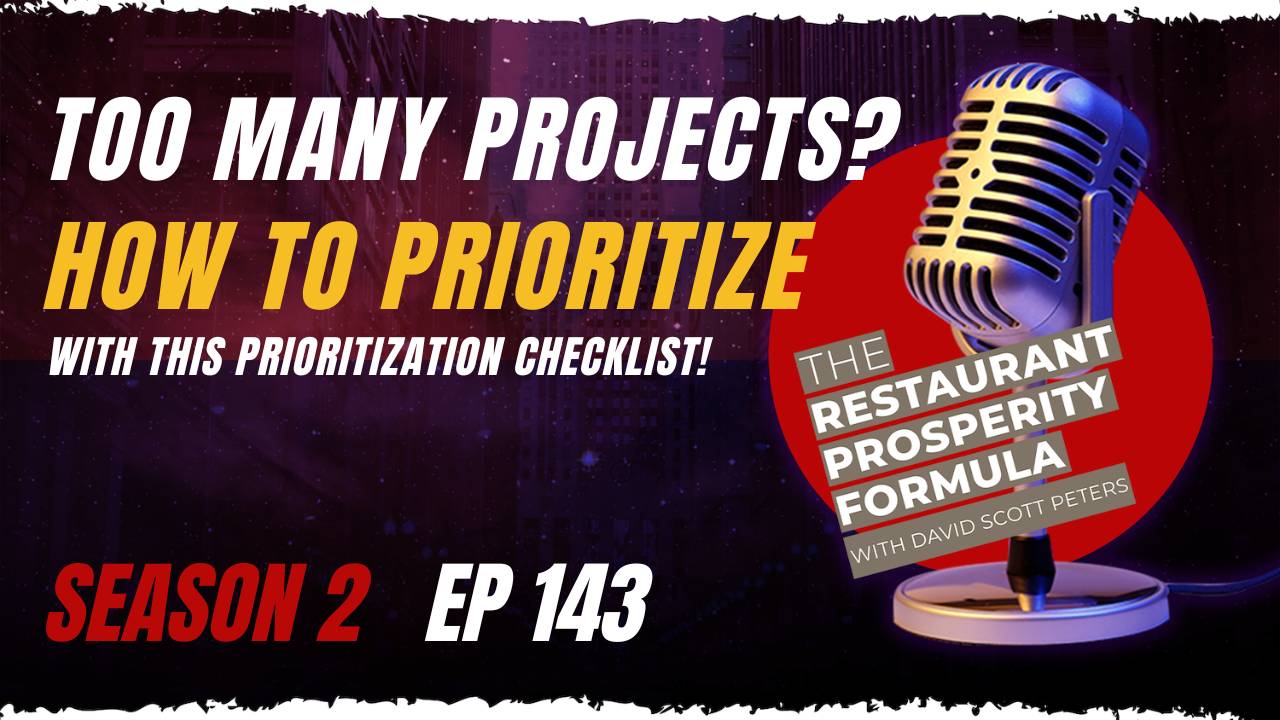
If you’ve ever started a year full of optimism only to find yourself buried under half-finished projects and mounting stress, this one is for you. In this episode of “The Restaurant Prosperity Formula” podcast, I dig into why so many restaurant owners feel overwhelmed despite working harder than ever — and why the real issue isn’t a lack of effort, but a lack of clear decisions. This episode walks through a practical way to cut through the noise, decide what actually matters right now and regain traction. Listeners can expect to learn how to distinguish urgency from importance, why too many priorities stall progress and how focusing on the right work — at the right time — creates momentum, calm leadership and real results.
Why overwhelm keeps showing up in restaurants
One of the biggest patterns I see with restaurant owners is that overwhelm masquerades as ambition. Big plans, long project lists, and constant motion feel productive, but they’re often symptoms of indecision. When nothing is clearly chosen, everything stays open — and open loops drain energy, focus and execution. In this episode, I explain why overwhelm isn’t caused by too much work, but by too many unresolved decisions competing for attention.
What “doing the right things” actually means
This episode reframes productivity away from “doing more” and toward intentional prioritization. I break down how clarity around goals, projects, and timelines changes everything. When projects are clearly defined and evaluated based on impact and urgency, it becomes easier to see which ones truly move the business forward and which ones can wait without real consequence.
How focus creates traction (and trust)
Trying to run multiple major initiatives at once doesn’t just exhaust owners; it overwhelms managers and teams. In this episode, I explore how too much parallel execution kills follow-through and quietly trains teams to disengage. By narrowing focus and sequencing work intentionally, leaders create an environment where projects actually get finished, accountability improves and the business gains momentum instead of chaos.
What changes when you lead instead of react
A major takeaway from this conversation is the shift from reactive leadership to proactive leadership. When priorities are clear, success is defined and ownership is assigned, the restaurant stops revolving around the owner’s constant presence. The result is less firefighting, fewer distractions and more confidence that the business is moving forward — even when shiny new ideas try to pull attention elsewhere.
Why this episode is worth your time
If you’re tired of being the glue that holds everything together, this episode offers a clear mindset shift and a practical framework to help you regain control. It’s not about hustling harder; it’s about choosing wisely. By the end, listeners walk away with a clearer understanding of how focus, sequencing and accountability lead to finished projects, calmer leadership and real progress toward restaurant prosperity.
Click the podcast player above to listen in, or you can watch the video on YouTube, click here to download the latest episode.
Read the full transcript.
Hey there, restaurant pros. It’s David Scott Peters, and welcome to the Restaurant Prosperity Formula podcast. For over 2 decades, I’ve been guiding restaurant owners to success with the proven principles of something I call the Restaurant Prosperity Formula. I originally created the formula based on the daily practices of the most successful restaurateurs I coached, and it’s now the foundation of what I teach restaurant owners like you so you can achieve success.
What do I mean by success? Success is a restaurant owner who dictates the terms of their life and their bank account instead of their restaurants dictating those things for them. Success is a restaurant owner who has freedom from the restaurant and the financial freedom they never thought possible. How you define success is up to you, but I do know the way to achieving it is using the Restaurant Prosperity Formula.
This season, I’m diving even deeper into the core elements of the formula: leadership, systems, training, accountability, and taking action. Along with my insights, you’ll hear from special guests, industry experts, and inspiring success stories from fellow restaurant owners who’ve turned their businesses around and found their definition of success.
In this episode, number 143, we’re tackling too many projects, no traction. How to decide what actually matters. Let’s get started.
But first, a word from our sponsor. Boost your restaurant’s performance with the Service With Style secret shopping program. Get comprehensive reports with photos, customized visit templates, a vast network of experienced shoppers, and a fantastic scoring system so you know exactly what your guests are experiencing. You control the frequency and rotation. No minimums, no contracts, no cancellation charges, and no hidden fees. Enjoy industry-leading reporting and scoring software, plus a 10% discount off the price and your first shop is free. Set up a quick call today at www..servicewithstyle.com forward slash DSP.
Restaurant pros, I’m going to start with a pattern I see on coaching calls all over the time. A member jumps on the call, says things like, “David, this year is going to be big for us.” At first, that sounds exciting. Growth, momentum, opportunity. Think about the optimism, the excitement about the new year.
But then, the list starts rolling. Construction projects, better use of systems, more accountability with managers, technology we’re paying for but not really using, EOS, marketing, succession planning. The list goes on. And somewhere around item four or five, the tone starts to change. Because what they’re really saying without saying it is, “I’m overwhelmed and I don’t know where to start.”
Here’s the truth. The truth that I want you to hear right now. You don’t have a project problem. You have a decision problem. Think about that. When decisions don’t get made, everything stays open, and open loops create stress, and stress kills execution.
Today I’m going to walk you through a project prioritization checklist that I use with my members to turn chaos into clarity. This is not about doing more. This is about doing the right thing in the right order. Let’s get started.
Step one is set the goal. So again, the first step on this checklist that I’m providing you is that the goal is not to do more projects. The goal is to decide what to do first.
Most restaurant pros think overwhelm means, well, they’ve got to move faster, work longer hours, push harder. But here’s the deal. Speed without direction doesn’t create progress. It creates burnout. If everything feels important, your brain refuses to choose. So you nibble, nibble, nibble, nibble at everything and finish nothing.
So step 2 on this list is list every project. This next step is very simple. List every project. But let me be very clear. One project per line. And for clarity’s sake, construction is not a project. Systems is not a project. Marketing is not a project. Those are umbrellas hiding multiple initiatives.
When you force yourself to write each project separately, something uncomfortable happens. You realize how much is actually on your plate. That’s not failure. That’s awareness, and awareness is how we make change.
What breaks if you skip this step? Well, think about it. Vague projects feel manageable. Vague projects lie. You think you can get more done, but honestly, all you do is create this list of things that quite honestly aren’t going to get done because you don’t know the first thing that needs to happen.
So step #3 is clarify each project. For every project, answer two very simple questions. The first question, number one, what problem does this project solve? Think about it. If I’m going to do this, what problem does this solve? That’s important.
The second question is, what happens if we do nothing for the next 90 days? Think about that. Right, we know what this solves, but if I don’t do anything for the next 90 days, what’ll happen?
See, if nothing truly bad happens in 90 days, the project may be important, but it is not urgent. Urgent and important are not the same thing. See, we can create a list where everything is important. That’s where the overwhelm comes from. Holy crap, look at all these important projects. There’s a very big difference between urgent and important. Everything’s important. Why the hell? Why would it be on your list if it wasn’t important? So we’ve got to really hone in on what’s urgent.
Step 4 on the checklist: sort these projects into 3 buckets. Okay, what do I mean by this? Now sort the projects into 3 buckets. These buckets are must do, should do, and nice to have.
Let me explain. Must do, right? The bucket of must do. These are things that have to do with safety, compliance, and cash flow. These are things that have hard deadlines. If this doesn’t get done, something breaks. Think about it.
The second bucket is should do. Systems, training, accountability, visibility, these create leverage. This is much of what we teach. Yes, while some of the systems that we teach become must-dos, many of them are should-dos.
When you start looking at, you know, a construction project, when you start looking at something like putting safety guidelines in place because you’ve had an injury, that’s much more important than adding some accountability.
And then there are times where we may have worked on your budget, your budget which was your must-do, and now the should-do of systems has turned into a must-do because now, with the budget, I need the systems in place to achieve that budget. See where I’m going here?
The third bucket is nice to have. These things are helpful, valuable, not critical right now. And that might be the marketing initiative. You’ve been wanting to play the leader of your restaurant, work on marketing, budgets, lead your team, develop your managers, hold them accountable, work strategically on the business, move it forward.
But you’ve got some must-dos that are in the way right now, where the marketing part of that is nice to have because you’ve got some big things that are critical to your business that cause harm if you don’t do something in the next 90 days.
If everything on your list is in the must-do bucket, that bucket is meaningless because everything cannot be a must-do. That is more than a crisis situation. That’s impossible.
Step 5 when it comes to this checklist is set the sequencing rule. So here’s the rule. One major initiative per quarter. Holy crap, what did I say? One major project, one big thing per quarter.
Now look, if some of these projects are light, maybe it’s two, max three, especially if you’re not in a position where you’ve got a management team and department heads and people that can take on some of these projects on their own, that they don’t need 100% of your time.
But you personally, one project, one project, one major initiative at a time. Maybe two or three if they’re light.
See, parallel execution kills restaurants. It overwhelms your managers. Take on too many projects and you say, “We’re making this change and this change and this change, we’re doing this and this and this,” and the management team starts to get overwhelmed.
It kills follow-through. Oh my gosh, where do I start? I just keep starting and starting and starting and starting, but never see anything through because there’s always something getting in the way. It trains your team just to wait you out. This too will go away. Another hare-brained idea, another big project the owner wants to get done. I just have to wait.
Step 6 on the checklist: choose the next 90 days. This is where the hard part comes in. Choose one project for the next 90 days. Again, maybe two or three, but be very careful here. Overwhelm is real.
Think about all the times you’ve looked at that list and you’ve started multiple things at the same time and none of them get done. That doesn’t do you any good. That doesn’t move the ball forward. That just creates overwhelm, again, burnout.
Everything else, if it’s not that one project, maybe two or three, they go into the parking lot. Not forever, just for now. If you don’t choose, your calendar will.
Think about it. If you don’t choose the one thing you’re going to work on, your calendar will because you’re going to get too busy and nothing gets done. And your calendar, well, it’ll choose poorly because that’s what’s been working for you up till now.
And when I say working for you, that’s how you’ve been doing your projects. It’s not been working because you’ve had initiative after initiative after initiative that just fail to get done.
Step 7 on the checklist is define success. This is huge. This step is a non-negotiable. Now hear me out. This could be the hardest part for any entrepreneur to do because I want you to have clarity.
I want you to write an outcome statement exactly like this: By blank, we will blank. By blank, we will blank.
So by implementing the system, we will save $30,000 a year. By implementing this system or this project, we will have our restaurant open in 90 days. Think about it. By blank, we will blank.
And those verbs aren’t necessarily implement, improve. It’s not “work on.” It’s examples like this, maybe. By June 30th, we will complete weekly MarginEdge reviews with our general manager. By June 30th, we will complete MarginEdge reviews with every GM.
So we’ve got multiple restaurants, you’re going through using MarginEdge software, you’re paying attention to your food and beverage costs. And we’re going to make sure weekly we review. Well, that’s very specific.
How about by quarter three? DSP systems, that’s me, David Scott Peters, are being followed and audited weekly. Notice that wasn’t that they were being implemented. They’re in place. But what we have not done is had that accountability. And so we’re going to make sure that they’re being followed and we’re going to audit them on a weekly basis. Very clear.
How about one more? By May 15th, the construction project is complete and open to guests. Opening the dining room, opening a new restaurant, you name it. Very specific and clear and has to be done. It’s a hard deadline. Those go into the must-do bucket.
If you can’t write the sentence, the project isn’t clear enough. Think about it. If you can’t write that sentence, it’s not clear enough.
Step 8, assign ownership. This is a big one. Every project needs an owner, one owner. And every project needs one person holding them accountable.
Now, for a lot of this, you as an owner, if we have multiple projects, we might assign it to our general manager, to our chef or kitchen manager, to someone else on the team. But you’re going to hold them accountable. One person owns it and one person holds them accountable. Without accountability, things do not happen.
If that person is always you, by the way, if you keep putting your name as the owner and the person who’s supposed to hold it accountable, if you’re on all these lists for all these projects, you don’t have a system. You have dependency. You have a restaurant and a management team, or lack thereof, that is dependent on you to do everything.
And if you are the only one to do things, this list of projects, whether it’s one item or three, is not going to get done. Because everything else in the day-to-day is going to, well, take you off course. There’s a new excuse, a new reason for not getting something done. And then burnout and overwhelm happen and you just give up.
Step 9 on the checklist: what are your next three actions? So you need to identify the next three actions. I’ve got to do this. So you’ve got your project, but you’ve got a list of actions, to-do lists, in order for it to get done.
So for instance, it’s almost like opening your restaurant in the first place. You had a timeline that you had to have plumbing done and electrical done and inspections on both those before you could have the drywall people come in and wall up the walls. Right? If this doesn’t get done, you can’t do this. If this doesn’t get done, you can’t do this. And after those are done, we do the next thing, the next thing, the next thing.
So you’ve got a project plan, all the steps, all the actions that need to happen in order to get your major initiative done. And you need to put due dates on each one.
Without a deadline, nothing happens. I can tell you that I am deadline-driven. Without a deadline, I can push something else very easily. I can find five other things that make me want to do those instead of the thing that I have to do. Without the deadline, it doesn’t get done.
But man, when I get a deadline, it is amazing the fire that gets lit under me. I’m going to make that deadline. If I miss it, it’s going to be very close. So deadlines are so important.
Big projects don’t fail because they’re hard. They fail because the first step is unclear.
Step 10 on the checklist is set accountability. We’ve got to find a way to close the loop. So what do we do? We schedule regular check-ins. And then we’re going to review things like progress, key metrics, and any blockers that are stopping you from getting things done or stopping somebody else who’s in charge of that project.
If these things are not reviewed, again, it’s not important.
Now here’s a bonus. What happens when a new project tempts you? Because that’s going to happen all the time. There’s always the, “Oh, I want to do this next thing. Oh, this is really important to me.”
Before adding anything new, ask yourself this: Does this replace the current priority or compete with it?
There is a good chance that something comes up and it is new, deadline-driven. Let’s take, for instance, you’ve got a major project in the kitchen. A pipe broke and it’s got to be fixed now or you’re not in operation. Well, that very easily replaces anything else you’re working on. That is deadline-driven. That is costing you money. That is doing a lot of damage to your business.
Or, man, I’d really like that. I saw this speaker talk about marketing and I want to do this new marketing project, but your plate is already full and that’s going to compete with what you’re working on. All of a sudden, it’s going to take your eyes off the ball, your eye off the prize, and you start working on the next new project, so the other one doesn’t get done.
So does this new project replace your current priority or compete with it?
Next, will this matter in 90 days? Right? It goes back to one of the original questions. What happens if I do nothing? What will happen in the next 90 days? We’re going to use the same pair of glasses to look at this project and go, “90 days, what happens?”
Because you have to decide, am I reacting or am I leading? As the leader of the business, am I reacting to something that’s gone on or am I truly leading my business forward?
Because this checklist we’ve gone over is all about leading your business forward, moving the company forward. Because you’ve determined this project is the one thing that must get done.
Now, most shiny objects are distractions in disguise. Especially as entrepreneurs, we want the next new thing. Often, it is very difficult to start and finish a project.
Now I want you to think about this. What is life like before the checklist? You’re in constant motion. You have half-built systems. You are the glue for the restaurant. Without you, doesn’t get done.
Now let’s paint the picture of what life is like after the checklist. You have clear priorities, finished projects, calm leadership. You have focus amongst all of the distractions that are going on in your business. You have determined that this is a priority for the business and we are going to see it through and get it done.
Restaurant pros, success isn’t doing everything. It’s doing the right things in the right order. That’s how you get traction. That’s how you get change in your business.
Don’t be overwhelmed. Don’t try and do everything at once. Understand the difference between urgent and important. Everything is important. But those things that are urgent, that fall into the must-do category, those are the things that truly make a difference in your business.
Ready to take the next step towards achieving restaurant prosperity, freedom from the daily grind, and the financial success you deserve? Book a discovery call with Ryan James to learn about our group coaching program. Ryan will guide you through how our program can transform your restaurant and help you achieve the prosperity and freedom you’ve been striving for. Click the link in the description below or visit DSP.coach forward slash talk dash to dash Ryan to schedule your call now.
Hey, that was an awesome episode. I want to thank you for taking the time to take action on building a better, more prosperous restaurant.
Before you go, I want to give you these three thoughts. One, by combining leadership and taking action with systems and training, being checked by accountability, you are on your way to creating prosperity for you and your restaurant.
Two, I have something I need from you. Please leave a review on Apple Podcasts, Spotify, or wherever you happen to listen to podcasts. By leaving us a review, other restaurant pros seeking out this information are able to find it. I read the reviews, and hearing how this information has benefited you does wonders for me.
And three, if you find any of the discussions helpful, share them. The more restaurant pros who have access to them, the better we become as an industry.
For more restaurant resources or to get in contact with me, connect with me at DavidScottPeters.com.
Be passionate about what you’re doing. Be persistent, but more importantly, become better and help everyone around you become better. And your restaurant is going to kick some *.