These days running a restaurant comes with a lot of technology. Starting with the most important, there is the POS system followed by website and social media management. After that, take your pick! Tech is available for reservations, online ordering, third-party delivery, scheduling, waitlists, loyalty program, food and beverage management, food safety, payroll, accounting, team communication, it’s honestly endless. Whatever tech you use, it is referred to as a tech stack. Times have changed since my family had its restaurant in the early 1980s when all you had to do was focus on delivering a great guest experience!
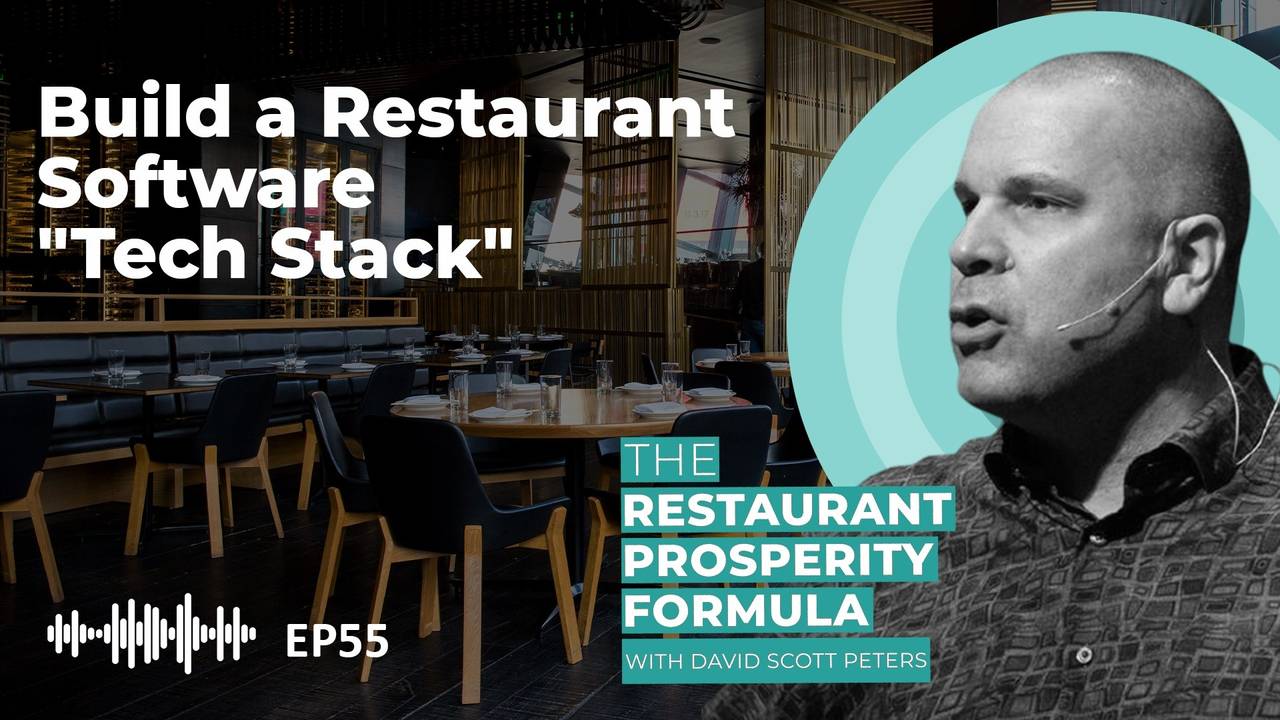
In this episode of my podcast, The Restaurant Prosperity Formula, I break down what I love about restaurant software and all the ways it can support you in the goals you have for your restaurant and your life. I offer my recommendation for how to make the most of technology and the pitfalls of relying on it too much. Lastly, I touch on overcoming the fear of the unknown, which is a major factor in using technology but also something that can hold you back.
You need software to run your restaurant today. It’s a must in all industries. There’s a term now called a tech stack, which I see as all the software, systems and apps you need to run your restaurant.
Let me tell you why I love software. As somebody who created software from the ground up at my former company, I love software as a restaurant coach, and I love software as a restaurant operator. It simplifies the process.
You may have this complex step by step process to do something, and often software can streamline it, simplify it, speed up the process. You don’t have to do double data entry or put the numbers in at all because it’s pulling directly from your POS system or another piece of software. The data is incredible because it allows you to proactively run your restaurant. With the data, you can see how you’ve done and make decisions on what you want to do going forward, what numbers you need to achieve, how you’re going to achieve that, what systems you need to put in place, because you have the data that tells you a story.
There are a lot of other reasons to love software, which I cover in this episode of the podcast. But be warned, even the best software isn’t useful if it isn’t used. There is no ROI on a software system no one uses.
My advice is this. You need software for every aspect of your restaurant business. But more importantly, you need to have systems in place that you and your whole team understand and follow. If you don’t have these systems first, start low tech. Document everything and establish the systems then get the software.
You as a restaurant owner need to understand that software is critical to getting things done in your business, to grow your business, to control your business, to simplify your operations, to ensure that people are doing things your way without you having to be there. But the truth of the matter is they are just tools to simplify tasks. Nothing replaces the knowledge, the training, the stick-to-itiveness of getting the work done. That’s what you have to focus on first.
Click the podcast player above to listen in, or you can watch the video on YouTube, click here to download the latest episode.
Read the full transcript.
Hey there restaurant pros, it’s David Scott Peters and welcome to episode 55 of the Restaurant Prosperity Formula. I’ve been coaching restaurant owners since 2003 and the Restaurant Prosperity Formula is based on what the most successful restaurant owners I’ve worked with do on a daily basis to achieve their success. The basic premise of the formula centers around achieving prosperity, freedom from your restaurant and the financial freedom you deserve. To achieve prosperity, you have to follow a very specific formula made-up of leadership, systems, training, accountability, and taking action.
Today’s topic, I want to talk about restaurant software and apps, the need for them, but more importantly, what you need to do before you even get one. In a moment, we’re going to explore the restaurant tech stack. Let’s get started. Let me start off by saying you need software to run your restaurant today. It’s a must. In all industries, there’s a term now called a tech stack. Now Google defines a technology stack as a set of technologies that are stacked together to build any application.
But in the restaurant industry, I see a tech stack as software systems and apps you need to run your restaurant. In this case, your restaurant is the application you build. Think about it. You need technology for marketing, restaurant operations, back office, and much more. Let’s take a look at what a typical restaurant might have in its tech stack. You’re going to have a point of sale system. This is critical, the most important piece of equipment you’re ever going to buy, software you’re going to invest in, your restaurant life. Because it gives you the data necessary to run your business, from collecting sales, collecting money, ensuring the money makes it there, to controlling labor, food cost, the list goes on and on, preventing theft. A point of sale system is the cornerstone to your tech stack.
You need a website application. Whether it’s you’re farming out to somebody else or you’re getting one of these sites that allows you to build your own site, maintain your own site that you can make changes at any given time. Because marketing is so important. Your website is your today’s business card. At any point in time, if I want to learn about you, find out where you are, see pictures, see what the menu’s like, price point, you need a website.
How about an application to post on social media? Hey, social media is incredibly important. I can remember the days when Instagram first came out and people were like, oh my God, I’m so tired of these people slowing down the tables, taking pictures of their food to post on Instagram. Oh, it’s annoying to where today, chef, you better put out an Instagram ready appetizer, an Instagram ready entree because we want to post this information. We want our team to do it. We want our customers to do it. But now there’s so many different applications out there. There’s software applications that you can post it in one spot and it boom, it’s in everywhere. It’s on Facebook, it’s on Instagram, it’s at other social media things. Doesn’t matter.
What about a reservation app? Yeah, well, if you take reservations, you know, the old phone up the restaurant and write it down in a book doesn’t work anymore. People want to do it right now. And so now all of a sudden I need a reservations app if my restaurant takes reservations. I need online ordering app, right? If COVID didn’t teach us anything, we’ve got to be prepared to have customers come in and take product out, increase our sales by increasing butts in seats and seats that don’t exist. But now you need technology to do that.
Oh, you need a waitlist app. All too often we get to a point where writing down and people going away or those really expensive pager type coasters and things that they hold in hands and they disappear. Whereas now everybody’s got a cell phone. Well, I need an app that can kind of predict when tables open up and I can communicate with my guests very easily by texting them. We need third party delivery apps. Again, before COVID hit, I was so against third party delivery apps, but today after COVID, it’s now a part of our society. We’ve just got to negotiate the rates down as much as possible and use as few as possible in order to still make sure our guests will order from us.
We need a scheduling app. you could write a schedule and post it like the old days, but people want to make changes to the app, swap schedules. You want to say there’s something available. You want a scheduling app, and especially if it’s going to communicate with your point of sale system. You need a food and beverage management app. We need recipe cards, ordering, inventory, right? We’ve got to make sure that we can predict what we need on the line. Maybe have a prep system involved. A food and beverage management software package, an app is so critical to you running your business.
And I would dare say that you must have this software, this application, because if you don’t have accurate up-to-date recipe costing cards, you are flying blind. You need an online checklist app. Yeah, I love online checklist as because why? Checklists are good enough as they are. Hey, just check, But when you take a picture of something. from a live camera, not from, can’t go to the camera roll, but a live photo, you can say, prove it to me, you did what I asked. All of a sudden there’s a certain level of accountability. When you can log on and see that they’re halfway through the shift and they should have been further along on their side work or ready to close and they’re not anywhere near done their side work, you can actually call up your restaurant and move it along without having to be there.
You need a food safety app. Like we have a legal and a moral responsibility to serve safe food. So you go to the old, what was a company called Day Dots where you can write, it’s got Monday, Tuesday, Wednesday and so on. You write the date on it and you say this is when it’s going to be expired and so on and so forth. But there are systems now where you can literally type it in, come out of a printer, have a scanner on it to do all these wonderful things from temperatures to you name it. Food safety app is extremely important today.
We need an LMS, a learning management system. Training, training, training is so gosh darn important. And now all of a sudden you’ve got all your training. Where do you host this training? How does it get delivered to your new hires or your existing employees? Are there tests? Well, now all of a sudden there’s an LMS app. How about a loyalty program app? There’s only three ways to increase your sales. Get people to… come in off the street, meaning brand new customer, most expensive form of marketing, get them to come back more often, get them to spend more each visit. Well, those last two, a loyalty program is critical to get people to come back more often and spend more.
Oh, I need a team communication app. We no longer can have these endless text strings because some people don’t want to give out their phone numbers, right? That’s an invasion of privacy. They don’t have to give out a phone number. But they want to be involved in communication. So now whether that’s what app you use does not matter, but all of a sudden we need a form of communication throughout the company.
Accounting software. Well, that’s a mic drop right there. If you don’t know what your numbers are, how the hell can you control your business? You need a payroll provider and their software so you can easily either upload your numbers or type them in so payroll is accurate and on time. not to mention all the apps on your phone just to produce social media content. And the list goes on and on.
Now, to an old guy like me, all I got to say is, wow, times have changed from when my family had its restaurant in the early 1980s, when all you had to do was focus on delivering a great guest experience. Just a great guest experience. Great food, great service, great atmosphere. That’s all you had to do. Because Costs were so much lower. Labor costs was really low. 14 if I can remember growing up. I mean, so that wasn’t a problem. Food was really inexpensive.
But today, all of a sudden, we need all these other software packages, these apps, in order to make money. because our costs are out of control. Labor cost is high, food cost is high, pork cost is high, all of our bills go up and then we add to it this tech stack and you say, hey, where’s my money going? But if we use the tech stack properly, it should make me money. com, I had initially started a restaurant training and coaching company back in 2003 when there was like nobody out there coaching. com, me and maybe two other people that were primarily marketing.
And that company turned into a software company because our members pushed us to develop an app because there wasn’t a lot of options out there. They really came down to the number one thing that pushed us was recipe costing cards. All the effort it took to do recipe costing cards and spreadsheets. And then as soon as you’re done, those cards are wrong because the next invoice came in were wrong. Unless you’re going to spend literally 20 minutes a day changing prices, changing prices in this spreadsheet. So they said, hey man, we need software.
Well, Today, it feels like there’s a new app released on a monthly basis. I mean, to run every aspect of your restaurant, competition is rampant. So it becomes even harder for you because you’ve got to choose. Well, let me tell you why I love software. As somebody who created software from the ground up, why I love software as a restaurant coach, why I love software as a restaurant operator, why I love software.
It simplifies the process. you may have this really complex step-by-step process to do something. And often software can streamline it, simplify it. can speed up the process. Because all of a sudden I don’t have double entry or I don’t even have to put the numbers in because it’s pulling directly from my POS system or another piece of software. The data. The data is incredible because it allows me to proactively run my restaurant. Because with the data, I can see how I’ve done and I can make decisions on what I want to do going forward. What numbers I need to achieve, how I’m going to achieve that, what systems I need to put in place because I have the data that tells me a story.
You can increase your sales with software. You can decrease your cost with software. You can make more money with software. It’s really difficult to say, my, chef, my general manager, or I’m old enough to go, I don’t do software. ********. You have a cell phone, a $1,400, you know, camera in your back pocket that’s a computer, that’s a TV. that is a recording device that has the spreadsheets and does everything and there’s an app for everything. Heck, it’s got a web browser. As long as you can put your finger on a screen and you can type some numbers in or words, software, the excuse of I don’t do software is gone.
Now with that said, let me tell you why I don’t like software. Here’s the challenge. A lot of people, and I used to sell software, I created it, I sold it. A lot of people call up and they want whatever app you’re selling, they think it’s a magic pill. That each app they get is going to solve their problem. That’s not true. If you put bad numbers in, you get bad numbers out. And you get bad numbers out, you make bad decisions even though you have software.
If you don’t use the damn software, it’s worthless. I’m going to tell you right now, if you don’t understand where the numbers come from, you can’t honestly use that technology properly. So hey, we do a recipe costing card. Fantastic. If you don’t understand yield test, if you don’t understand a spice factor, if you don’t understand about menu mix, if you don’t understand what it is to make sure that you create your own soups, sauces, side dishes before you do anything else, all of a sudden, if you don’t know the ins and outs of what you have to do, then you can spend all the time and energy creating these recipe costing cards that do nothing for you.
And then what do you do with them if you don’t understand that we use those accurate, up-to-date recipe costing cards with our POS system to know what our customers actually purchased and what we sell it for to find out what our ideal food costs and how we can use that to menu engineer? Oh, by the way, if you don’t hold people accountable to the damn software, To the daily tasks, you’re wasting time and money. You can bring in the greatest software in the world. If nobody uses it, it’s worthless.
I have a phrase, or a saying I should say, that I always tell people. Bad systems used on a daily basis are priceless. The greatest systems in the world not used on a daily basis are worthless. And so all too often, operators invest all this money in this software, They don’t use it and they’re just burning money. They’re burning time. They’re making themselves feel awful because they spent all this money on this software. Nobody’s using it. Nobody’s getting the data. And they think maybe tomorrow, maybe tomorrow we’ll start to use it.
So here’s my advice. My advice is this. You need software for every aspect of your restaurant business. Every aspect from marketing to cost controls, to human resources, scheduling, I mean, you name it. You need to have software for every aspect of your business. But more importantly, you need to learn how to do something. You need how to learn how to do that task first. Right? What is that system, the process away? Learn it, understand it.
Again, going back to recipe costing cards. If you don’t understand how to do recipe costing cards, you’ve never learned it, you need to learn it before you get the software. And as you do so, start tracking low tech. If you’ve got to do your recipe cost cards by paper and calculator, move into a spreadsheet, then move into the software. So you need to create your system, your process, your way in anything that you want to do.
Find out all the ins and outs of that system. where your choke points are in the system and how software might speed up that process, how software might make it easier, how software might give you better results. And even still, before you do that, you’re using this low-tech system, you’re creating your system, you’ve got to make sure it’s used on a daily basis. Because if you don’t do that, if you don’t hold people accountable to using those systems on a daily basis, they will go away the moment you take your eyes off them.
And once you’ve done all those things, then go find your software solution specific to your need. The system that you know you want to speed up, simplify, make it easier, get better results. You need to ensure your management team is using the systems on a daily basis and this lies directly in the lap of the restaurant owner. Because you have to inspect what you expect. You cannot invest in all these software packages and hope they’re using them.
You have to have either someone on your team do it for you and report to you, or you must log into each one of these systems on a daily basis and inspect what you expect, ensure that they’re using the systems. Because if you go three days without somebody making sure the daily sales reports have been put in, you can’t order properly, you can’t schedule properly. If you don’t ensure that every invoice that was supposed to come in that day doesn’t get put into the software and you go to order, you’re going to over order because why? The system thinks you still have money to spend.
If you don’t track labor on a daily basis and make changes day-to-day, then you’re going to get to Friday and look at your POS system and run like a chicken with your head cut off going, cut, cut, cut, because you missed 5 opportunities already to reduce what you already blew in a labor budget on a Monday. You’ve got to make sure it’s being used. You must use that data then to actually proactively run your business, to create budgets, to create budget variance reports, to look at your business and start thinking strategically about your business and what systems you’re going to put in place to make changes to that data.
See, the data is a rearview mirror. What we do with it proactively, when we start to think strategically about your business and you say, this is what I can do with that data. Here’s what I need to change, whether it’s change my food cost by changing my menu, reduce my labor cost by reducing the number of steps it takes to make items or reduce prep. See, all of a sudden with that data, you can run your business proactively.
See, the long and short of it is this. Software, apps, really don’t know what the difference is anymore. Like they’re synonymous. I guess the old days, old timers like me, software was downloaded or loaded onto a computer where apps are now in the cloud. I mean, for the most part, do you really download any software onto a computer or onto your phone anymore? They’re apps, right? It’s just another fancy word for software in my world.
But the long and the short of it is software and apps are simply tools. Nothing is going to replace knowledge. You have to take the time to go learn. This is why my group coaching program and my one-on-one coaching and my mastermind group, these restaurant owners are amazing. Because they’re learning the systems first. They’re learning why you do something, how the numbers connect, how if I don’t do this, it affects that. And then they’re getting into software for the most part. Most don’t come to the table ready to go.
Some come in and they have software which they’re not using. Oh, I really got to get into that costing software, but we get slowed down or dot dot dot dot. They haven’t developed the habits, the knowledge, the tools necessary to even utilize that software properly. But by joining my group, they do that. They’re on a quest to learn. And they know to share it with their management team. They know that doing the work And ensuring it gets done is critical. That’s why they have an implementer. That’s why they have a restaurant owner checklist where they check certain things on a daily or every few day basis. They ensure the process is working.
Software is merely a tool. It doesn’t matter if you’ve got bad numbers, put them in, you get bad results out. Whether it’s a spreadsheet or software, doesn’t matter. Garbage in, garbage out. It doesn’t matter if you have a spreadsheet, a paper system, or software. If you don’t ensure it’s getting done, it’s worthless. You as a restaurant owner need to understand that software is critical to getting things done in your business, to grow your business, to control your business, to simplify your operations, to ensure that people are doing things your way without you having to be there.
But the truth of the matter is they are just tools to simplify tasks. Nothing replaces the knowledge, the training, the stick-to-itiveness, if you will, of getting the work done. And that’s what you have to focus on first. While I will hear, I’m here to tell you I love software and you need software for every aspect of your business. Heck, I gave you what the tech sack may look like and I’m sure there’s more to what that list is for you on a day-to-day basis.
But the truth of the matter is you need to be on a journey to learn why. You need to be on a journey to create your system, your process, your way. You need to be on a journey to start low tech and ensure people are doing it first. Find out where those choke points are, fix the solution, develop it, then look for the software that simplifies, that makes your life easier. And Don’t get so hung up if they don’t communicate with each other.
Hey, I don’t want this software because it doesn’t communicate directly with my POS system. There’s imports, exports. Make sure the software you choose is the one that you’ll use. And that’s really the critical point. All these software packages do about the same thing. They may have different user interfaces, maybe a couple different reports or features. But the math behind it is the math. Math is math.
So whatever one you choose, make sure it’s the one you’ll use. Well, this is your coach, David Scott Peters signing out, letting you know that you’ve got to have software, but it starts with knowledge, and I’m really glad you’re here to learn. Make sure you check out additional podcasts for more information on how to run a more profitable restaurant. Hey, make sure you go to my YouTube channel, David Scott Peters, where I post weekly tips.
I’m here for you. Go out there, kick some *** and we’ll see you on the other side of your tech stack. Hey, that was an awesome episode. I want to thank you for taking the time to take action on building a better, more prosperous restaurant. Before you go, I want to give you these three thoughts. One, by combining leadership and taking action with systems and training, being checked by accountability, you are on your way to creating prosperity for you and your restaurant.
Two, I have something I need from you. Please leave a review on Apple Podcasts, Spotify, or wherever you happen to listen to podcasts. By leaving us a review, other restaurant pros seeking out this information are able to find it. I read the reviews, and hearing how this information has benefited you does wonders for me. And three, if you find any of the discussions helpful, share them. The more restaurant pros who have access to them, the better we become as an industry. com. Be passionate about what you’re doing. Be persistent, but more importantly, become better and help everyone around you become better. And your restaurant is going to kick some ***.