
Every week I host a coaching call for a group of restaurant owners who are part of my premium coaching program, Restaurant Transformation Intensive. This is a group of restaurant owners who understand the importance of being the leader their restaurant needs. They understand the importance of systems, training, accountability and taking action.
They have the same struggles you do. What sets them apart is they are willing to invest in their future, they are willing to change, and they are not too proud to accept help, understanding there has got to be a better way. Ultimately, they are all working toward restaurant prosperity, which is freedom from their business and the financial freedom they deserve.
Every week we talk about what is going on in their restaurants that might be making them feel like a prisoner in their businesses. This week we talked about how their team members might be making them feel like a hostage in their own business. They’re so afraid of losing their managers, they hold back on adding more to their plates and then don’t question them when things aren’t done right. That leaves the restaurant owner in a lurch – doing all the work and cleaning up after everyone else.
While this hostage situation isn’t unusual in the restaurant industry, it is heightened right now with the shortage of staff and the increase in sales. Most owners are already working as many hours as they can in the restaurant and if a manager quits, they have no one to pick up those 40+ hours.
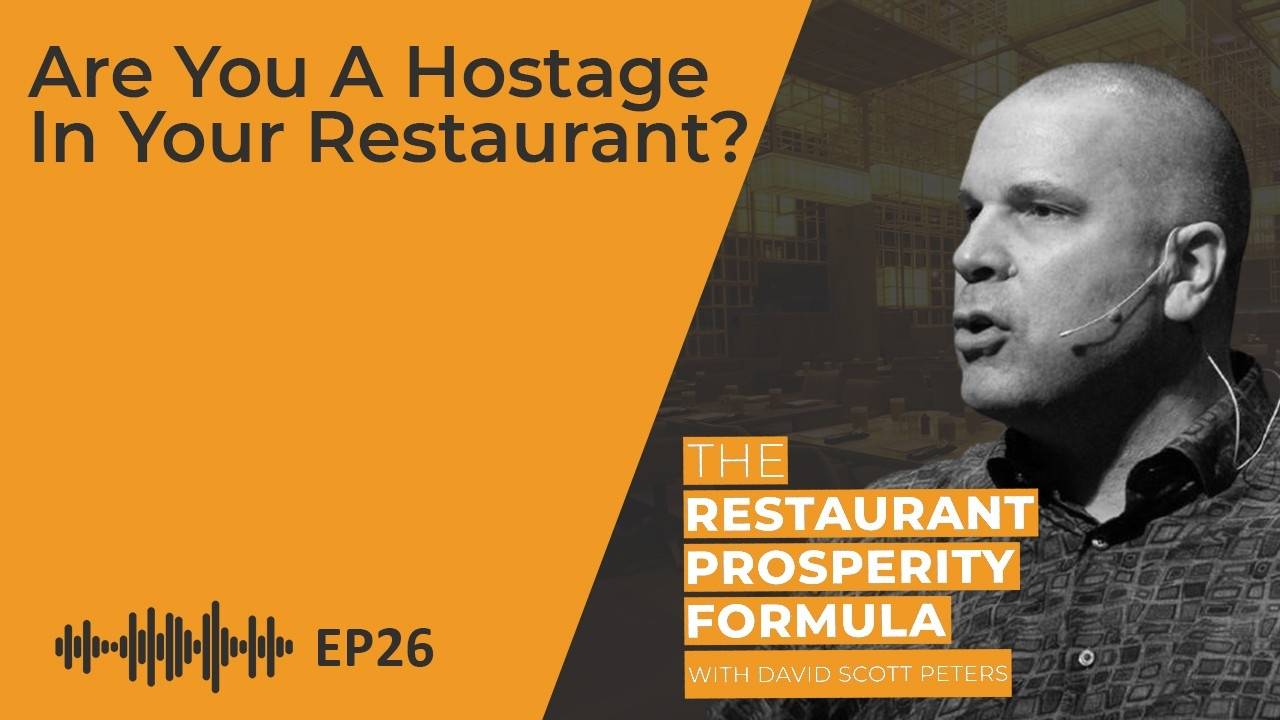
So how do you fix this situation? How do you negotiate your way out of the situation? In this episode of my podcast, The Restaurant Prosperity Formula, I outline the four things you must do to build a team of reliable managers that allow you to focus on the right jobs for an owner AND give you confidence to leave the restaurant for scheduled time off.
It’s OK to empathize with your managers. It’s OK to want to help them be successful.
It’s not OK to do their jobs for them. It’s not OK to enable them not to think because you do the thinking and solving for them. It’s not OK to operate from a place of fear.
Become the leader your restaurant needs by inspiring, teaching, correcting and pushing your managers to be the best they can be, all while executing their duties as managers as defined by you. You may or may not be the problem, but I will tell you that you are 100 percent the solution.
Click the podcast player above to listen in, or you can watch the video on YouTube, click here to download the latest episode.
Read the full transcript.
Hey there restaurant pros, it’s Dave Scott Peters and welcome to episode 26 of the Restaurant Prosperity Formula. I’ve been coaching restaurant owners since 2003 and the Restaurant Prosperity Formula is based on what the most successful restaurant owners I’ve worked with do on a daily basis to achieve their success. The basic premise of the formula centers around achieving prosperity, freedom from your restaurant and the financial freedom you deserve. To achieve prosperity, you have to follow a very specific formula made-up of leadership, systems, training, accountability and taking action. Today’s topic centers around one of the biggest challenges any restaurant owner faces on a daily basis, being fearful to ask more from their managers.
I’m sure you can relate. In just a moment, I’m going to share with you why this has become such a challenge in our industry and more importantly, how you can overcome this fear. Let’s get started. Let’s talk about getting over the fear of accountability. So a few hours ago, We just finished our weekly group coaching call for my restaurant transformation intensive members. These are a group of restaurant owners who understand the importance of being a leader in their restaurant, the leader their restaurant needs. They understand the importance of systems, training, accountability and taking action. Sounds familiar, doesn’t it? They have the same struggles you do. What sets them apart is they’re willing to invest in their future.
They’re willing to change. and they’re not too proud to accept help. Understanding there’s gotta be a better way. Ultimately, they’re all working towards restaurant prosperity, which is freedom from your business and the financial freedom you deserve. In fact, we talked about what was going on in their restaurants that might be making them feel like a prisoner in their business or how their team members might be making them feel like a hostage in their own business. Does that sound familiar to you? Let me paint you a picture that you just might identify with.
Imagine this, having this feeling that your employees are holding you hostage, that you’re so fearful of this labor shortage, you’re so fearful of pushing people too hard that you can’t give them more to do. You can’t hold them accountable. You can’t do what you need to do to make your business run forward. So you start making up for all those weaknesses, all the things people aren’t doing. Imagine you’re enabling them not to think. Like, have you ever found yourself where you grabbed your cell phone as you’re sitting at dinner, finally you’re able to have a meal with your family and you get a text message, where’s the plunger? And you’re like, you got to be kidding me. Where’s the plunger?
See, what happens is you’re so good at fixing everything. You’re so good at answering all of the challenges that come across that your managers don’t have to think, where’s the plunger? Let me just reach out to the owner. Let me find out right now. And you answer back and you keep reinforcing that you’ll answer. I don’t have to think as a manager. I want you to imagine, again, that fear of adding too much to their plate, your manager’s plate. my gosh, if I add one more thing to my manager’s plate, if I ask them to take inventory, work on recipe costing cards, we’re so short staffed right now, they’re going to leave me. They’re going to quit. And then where will I be?
And ultimately, imagine, do you have a fear of holding your managers accountable? Right? Do you understand? Holding them accountable. Now, if you’ve been following me for any length of time, you know that I changed the word accountable. to answerable. See, as long as I teach somebody what their job is, how to do it, how well it should be done, more importantly by when they demonstrated back to me, now I can hold them answerable. See, they know their job, their obligation, which is their job. They make a decision, are they going to do their job or not? And then they’re answerable for the resulting consequences, positive or negative.
Now, what I just described to you as far as those challenges of feeling like a prisoner or Again, being held hostage, not wanting to give your managers too much, being fearful that they’re going to leave you. That is normal. And it’s unfortunately contagious right now in our industry. I cannot tell you. I just spoke at CaterSource and I talked to somebody who’s been following me for over a decade and talked about his multiple locations and how he’d love to ask his managers to do more, but he’s fearful. What if they leave? Here’s somebody who’s very successful, multiple locations, been kicking *** has the majority of the systems that I teach in place.
But why is it as we as entrepreneurs are fearful to ask people to do the job we hired them to do? Really, that’s what we’re talking about. Well, that labor shortage really puts us in that bind. It’s also because we’ve had turnover in the past. We can’t find people today. And it makes it very difficult for you to run your business because here’s the deal. That fear of holding your managers accountable, that fear of giving them too much, that fear that keeps you a prisoner in your business equals you losing your managers right in your brain. That’s all it is. That fear is ultimately I can’t do these things or I’ll lose my managers. And I know what you’re thinking. How could I possibly put another hour in work?
David, maybe two years ago I bought into your work on your business, not in the business. I embrace systems and change. I bought into everything you said, David. And then there’s this thing called COVID, COVID-19 that hit us. It shut us down. Then when we reopened, we had to shrink our management team, shrink our employees. We had to jump back into the business in order to survive, to not be one of the 40% of the restaurants that became a statistic. And now we’re 18 months into it and we feel like there should be a reprieve. In fact, all this business is coming back, record sales. But my customers aren’t nice anymore. They’re berating my employees. They’re beating me up on Yelp. They’re being so inconsiderate and unfair.
And now I’m working everybody as much as I can. I’ve got managers working stations as servers or as cashiers. because I don’t have enough team members. I’m in there taking inventories, placing orders. David, what do you want me to do? If I add one more thing as I’m burning out my employees, add one more thing, what am I going to do when I lose my managers? I get it. That fear, that fear is real. Don’t let me come across as if I’m about to poo poo the fact that you have fear. that your fear is not based in a little bit of reality. But the truth is there is a solution to this. It may not be the easiest solution. It’s not the fastest solution, but there is a solution. I’ve seen it work time and time again.
Now, we’ve never seen a time like we’re operating in today, but we’ve always found challenges. We’ve always come across challenges that stop us dead in our tracks. This is not the first labor shortage we’ve ever experienced, but it’s certainly the worst. So let’s talk about the solution. How do I change this fear around to some confidence? Confidence in running my business, leading my team, being the leader my restaurant needs. Well, it starts with systems. Remember, I’m the systems guys. Systems, systems, systems. It’s your system, your process, your way. That means we’ve got to document, we’ve got to put together our systems, how we count our bar door to $300, one way, your way.
How we want to open and close the restaurant, opening and closing side work checklist by position, your way. analyzing dollars flavor worked your way placing an order on budget your way oh having a budget and operating to it your way creating your plan for success your way do you get it see there’s a system a process a way to doing anything and everything in your business but you’ve got to make sure you define it can’t be common sense it can’t be follow that person you’ve got to have your systems your process your way next It’s great training. So now you got a system, you got your process your way, but if nobody knows how to do it, how the hell is it going to be done?
And I will tell you training is not showing somebody once and saying, oh, I told them, I can’t believe they can’t do it. Training is ensuring they can do it on their own. Now in my group, Restaurant Transformation Intensive, my group of restaurant owners that are trying to change their lives, who are in there with their implementers, We spend the time almost every week talking about how they’ve got to make sure they train their management team on their systems. Whether it’s the systems that I’m teaching and providing you or your own, it doesn’t matter. And what that means is you can’t just show somebody you’ve got to do this. You’ve got to come in and say, here’s the responsibility. Here are all the steps to that responsibility.
Now I want you to do it. Watch me do it. I guess let me do backwards. Let me watch me do it. Now we’re going to come in the next day. Let me watch you do it. Let me watch you struggle and ask me questions. Let me assist you. Let me jump in, take over a little bit, back off. Let me come in the next day. Watch you do it on your own and maybe you ask a couple questions. Let me come in another day. Let me come in just as many days as it takes to be necessary to have you show me you’ve got it, that you understand what the job is, how to do it, how well it should be done, more importantly by when. See, when you’ve got that, now I know you’ve been trained, not just tell you once and hope you got to have common sense.
The next thing we’re going to do is add milestones. If you’ve spent any time listening to my podcast, And here how I talk about accountability. Accountability is not a dirty word. It’s also in order to do so when you assign something to somebody, you’ve got to put milestones in, check-in points if you will. See, we just don’t abdicate, give it to a manager, hope they do it. We say this is what we want done, how well we want it done, by when. Oh, and here are the milestones. By this date you’ll have this much done, by this date you’ll have this much done, and so on and so forth. You’ve got to follow up with milestones.
Even if it’s something as simple as filling out a manager log, that your expectation is they will have X percent of it done before the end of the shift, and this is by the completed manager log by the end of the shift. I can check in on those things. And when I check in and it’s not being done, I have an opportunity to retrain, refocus their effort, answer their questions, ensure they can be successful. The next thing you want to add is I want you to view accountability as an opportunity to coach. See, accountability is not a dirty word, right? I’m gonna hold you accountable. That’s me hitting my hand right with my fist going accountability. That’s what managers hear. Accountability truly is not a dirty word. It’s an opportunity to coach.
I want you to think about it. If you’ve ever been an athlete, was your coach nice and huggy and don’t worry about it. Hey, you can get it in there next time. Or they, hey man, this is what I need you to do. Work at it, work at it. When you don’t do it right, they correct you, correct you. They might be hard on you, pushing you to be the best you can be. And then when you achieve it, they’re your biggest cheerleader. Now is that a coach? Is that coach mean? Yes, there are some mean coaches out there, but it is truly them trying to push you to get the most out of you, raising expectations of who you are, teaching you how to be the best you can be, ensuring by holding you accountable to those standards, you are the best you can possibly be.
That’s what you need to be, a coach in your business. See, here’s the deal. If I am accountable, if I hold people accountable, again, AKA answerable, that equals consistency in your business. That means every manager is following the same policies held to the same standards. No favoritism, no nothing. And everybody’s towing the right rope. Everyone is getting the job done. See, accountability is often like the way I view discipline because often we think of the same thing. And oh, by the way, if you go into Webster’s dictionary, look up discipline. There’s an obsolete. It says obsolete definition means to teach.
So if we look at this accountability, this discipline model, if you will, we want to treat every manager, every manager, I don’t care if they’re related to you, how long they’ve worked for you, I don’t care if you love them to death. Everyone’s held to the same standard and we follow discipline or accountability, much like we would think of a cast iron coffee pot. See, a cast iron coffee pot, when it gets hot, it whistles, right? So it gives you a warning. Cast iron coffee pot, when you touch it, burns you. It’s immediate. A cast iron coffee pot, no matter how many times I touch it, burns me every single time. It’s consistent. And oh, by the way, no matter who touches that cast iron coffee pot, they get burnt. It’s impersonal.
See, that’s how you have to view your accountability. You can’t have favorites. You can’t have rules for these people and different rules for those people. This requires you as the restaurant owner or general manager for that matter to become the leader that restaurant needs, your restaurant needs. That we’re going to hold everybody to the same standard, which is not a negative if you take the time to ensure they know how to do their job. Did you know that most employees leave your business in the 1st 90 days because they don’t know how to do their job? and they usually have a bully manager above them trying to hide the fact that they don’t know how they’re supposed to do their job either. So they got to make that person feel small.
See that training portion, that training portion is critical to you making sure your managers embrace the new responsibilities. They understand what they’re supposed to get done, the how well, the by when, and they understand it’s a part of the JOB what they got hired for. See, I’m going to tell you right now. It’s okay to empathize with your managers. I can tell you, as a manager in the past, I want to make sure my owner feels my pain, understands where I come from. It’s okay to want to help them be successful. In fact, I expect that from you. That’s what makes you a coach. That’s what brings out the best of your people is you as the leader your restaurant needs. But I’m going to tell you right now, It’s not okay to do their jobs for them.
Do you understand? It’s not okay to swoop in and be a superhero and open up your shirt and have that super S on your chest that you’re God’s gift to your restaurant. You’ll fix everything. It’s not okay to enable them to not think. You know, instead of your managers coming to you, where’s the plunger? It’s where do you think it is? Hey, we’re about to go over budget on this order. What do you want me to do? What would you do? Hey, I’ve got this customer who’s calling up and I’m pretty sure they didn’t order from us and it’s a fake deal, da da da. How would you handle it based on our core values? See, you’ve got to take the time to allow them to think, to give them probing questions. Don’t answer everything. Don’t do everything for them.
Otherwise, you are going to be a prisoner to your business because you’re the best employee you have. See, it’s not okay to operate from a place of fear. You, my friend, you need to become the leader your restaurant needs by inspiring your team, teaching your team, correcting your team, and pushing your management team to be the best they can be all while executing their duties as a manager as defined by you, your system, your process, your way. See, The key is you taking the time to ensure they understand their job, right? What their job is, how to do it, how well it should be done, more importantly by when. See, you may or may not be the problem.
And I’m going to go out on a limb and say when there’s not accountability, you are the problem. But I’m going to tell you this. When you take the time, To invest in your management team, in training them, supporting them, coddling them, pushing them, holding them accountable, truly helping them become the best they can be, you will not get the pushback that you think you’re going to get. You get pushback when you just show them and hope they remember. you won’t get that pushback because you’ve taken the time to invest in them. You will not get them to feel so overwhelmed because you’re not dumping a ton of crap work on them overnight expecting them to get it done. You’re training them, making sure they got it.
And when they’ve got it and they do it on their own, you’re training them on something else and you’re pacing how you add them in place because we don’t change things overnight. It takes time. But we eventually get there that they know exactly what their job is, how to do it, how well it should be done, more importantly by when, even if it’s multiple new things that have been added over the weeks, months or years. See, I’m going to tell you this. While you’re the problem and you’ve got to own it, here’s the wonderful part about things. Once you know that about yourself, once you know what’s going on in your business, I’m going to tell you this. The good news is You’re 100% the solution. Hey, that was an awesome episode.
I want to thank you for taking the time to take action on building a better, more prosperous restaurant. Before you go, I want to give you these three thoughts. One, by combining leadership and taking action with systems and training being checked by accountability, you are on your way to creating prosperity for you and your restaurant. Two, I have something I need from you. Please leave a review on Apple Podcasts, Spotify, or wherever you happen to listen to podcasts. By leaving us a review, other restaurant pros seeking out this information are able to find it. I read the reviews, and hearing how this information has benefited you does wonders for me. And 3, if you find any of the discussions helpful, share them.
The more restaurant pros who have access to them, the better we become as an industry. For more restaurant resources or to get in contact with me, connect with me at DavidScottPeters. com. Be passionate about what you’re doing. Be persistent, but more importantly, become better and help everyone around you become better. And your restaurant is going to kick some ***. If you’re tired of not being able to leave your restaurant because no one else knows how to run it, I want to make sure you know it doesn’t have to be that way. You can leave your restaurant. It is possible to build a team of people who know how you want the restaurant to run. With these trained and responsible people in place, you can give yourself time away.
What would you do if you had time away from your restaurant? Would you sleep better? Would your relationships improve? Would you feel more relaxed? These are all things you deserve to experience as a business owner. It’s why we own our own businesses. If you would like to learn how to own a restaurant that doesn’t depend on you to be successful, click the link in the description to watch a free training course that teaches you exactly what you have to do. Also be sure to subscribe to get my weekly tips and watch these two videos to get more information and guidance for running a successful restaurant.